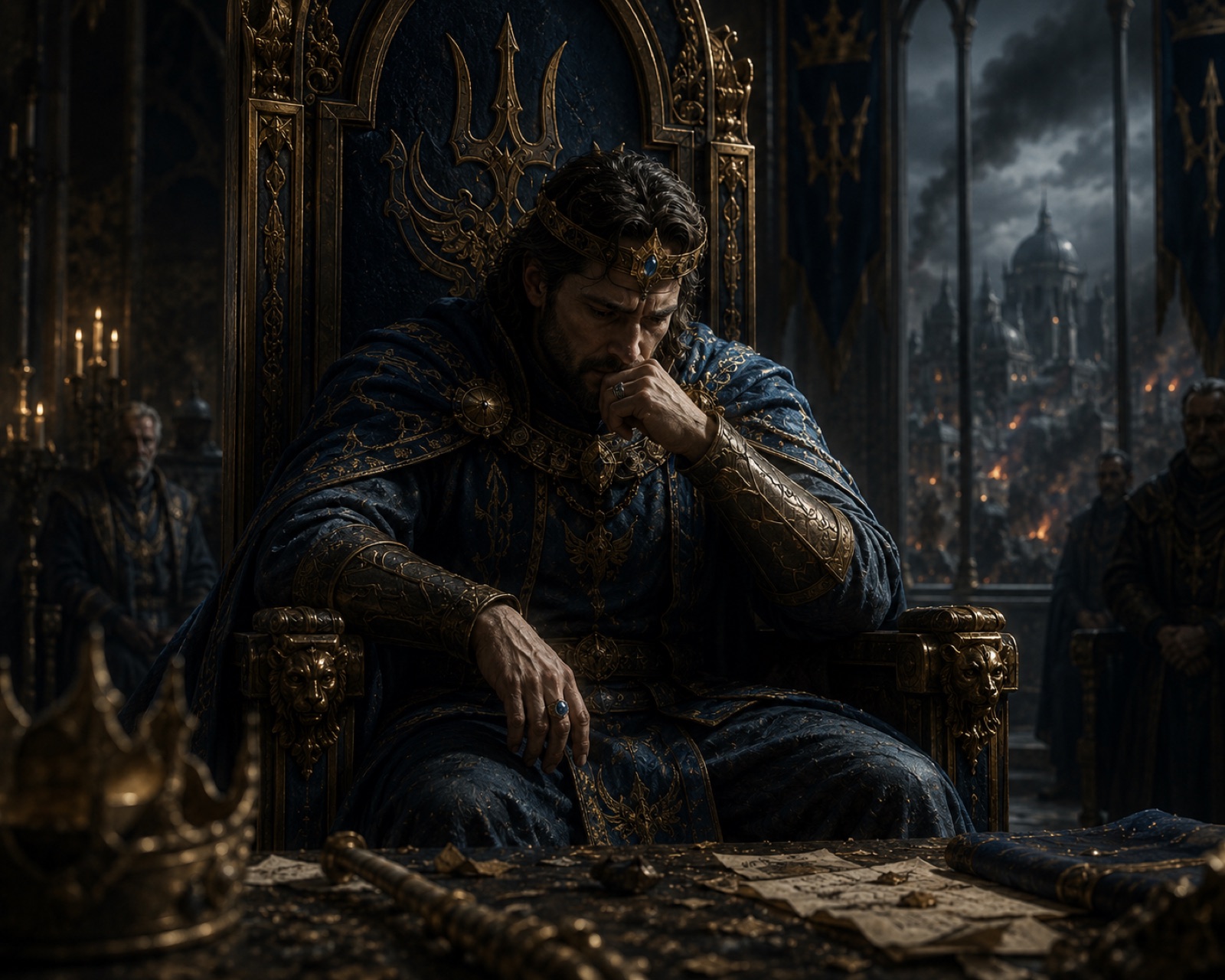
Chapter One: The Early Years
Long before the people of Sartonia called him The Returning Prince, Velther was simply another forgotten child of the lower districts.
He was born with nothing.
His mother worked whatever labor she could find along the canals and crystal foundries of Sartonia, often leaving before sunrise and returning long after darkness had settled across the city. Even then, her wages were rarely enough. More often than not, it was the Sapphire Crown itself—through public granaries and food subsidies—that ensured there was bread on the table. Velther never forgot where those meals came from.
The streets raised him as much as his mother did.
There was no formal education waiting for him, no tutors, no academies, no mentors. Yet Velther possessed a sharp mind. While other children learned mathematics and philosophy from scholars, he learned by watching merchants barter, sailors navigate, and guards patrol the streets. Every mistake carried a consequence. Every lesson had to be earned.
He grew quickly, but not kindly.
As other children chased popularity, festivals, athletic contests, or dreams of noble service, Velther's thoughts rarely wandered beyond tomorrow's meal. He watched children his own age laugh with parents who adored them, sleep in warm homes, and complain about inconveniences he could scarcely imagine having the luxury to notice.
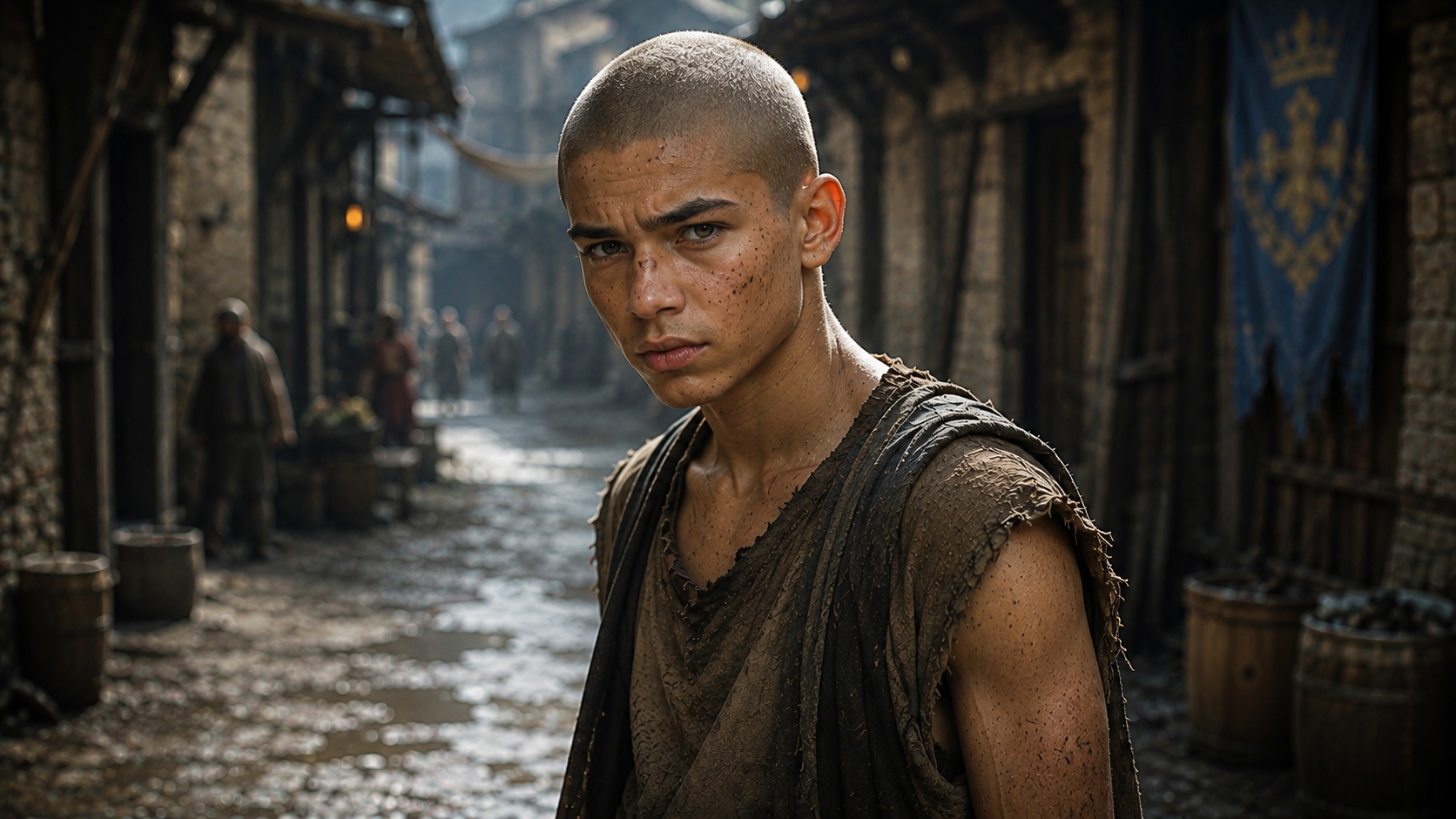
Resentment quietly settled into his heart.
He came to believe that comfort made people weak. Privilege blinded them to sacrifice. The things others valued—wealth, status, admiration—held no meaning for him. Instead, he understood only a handful of truths: survival, discipline, honor, unwavering duty to the Crown that had fed him when no one else could, and the bitter determination to never again depend upon another's mercy.
When he came of age, there was never any question about his future.
Velther volunteered for military service the first day he was eligible.
To him, war was not glory. It was for a purpose.
He believed the only thing he had ever been born to do was stand between Sartonia and those who would see it destroyed. On the battlefield he discovered what the streets had unknowingly prepared him for. Hunger had forged endurance. Hardship had forged resolve. Every struggle of his childhood had become another weapon.
He became an exceptional warrior almost immediately.
But beyond the battlefield, there was little else.
He had no understanding of family beyond vague memories of his exhausted mother. Community meant nothing to him. Love was a language he had never learned. He trusted only the warriors standing to his left and right, and only because they shared the same oath.
The rest of the world could burn.
As long as Sartonia endured.
Chapter Two: Peace Service
For Velther, there had never been another path.
On the first day he was eligible, he swore his oath to the Sapphire Crown and joined the ranks of Sartonia's defenders without hesitation. While many recruits struggled to adapt to military life, Velther seemed to have been preparing for it his entire childhood.
The instructors sought to break old habits and forge soldiers from ordinary citizens. For Velther, there was little left to break.
Discipline had already been carved into him by hunger. Endurance had been taught by long winters and empty cupboards. Obedience to duty came as naturally as breathing. Every hardship the army placed before its recruits was one he had already learned to survive years before wearing a uniform.
He excelled in every exercise.
When formations assembled before dawn, Velther was already waiting.
When the company marched, he never complained.
When rations ran thin, he quietly ate his portion without protest.
Rain, cold, exhaustion, and endless drills seemed to affect everyone except him.
His fellow soldiers often mistook his silence for indifference until they realized something remarkable. Velther never asked anyone to work harder than he did himself.
Without speeches or commands, he became the standard against which others measured themselves. Whenever morale faltered, weary eyes inevitably found him somewhere near the front of the column, carrying the same weight as everyone else and never once allowing his determination to fade.
He was not a source of happiness. He was something rarer.
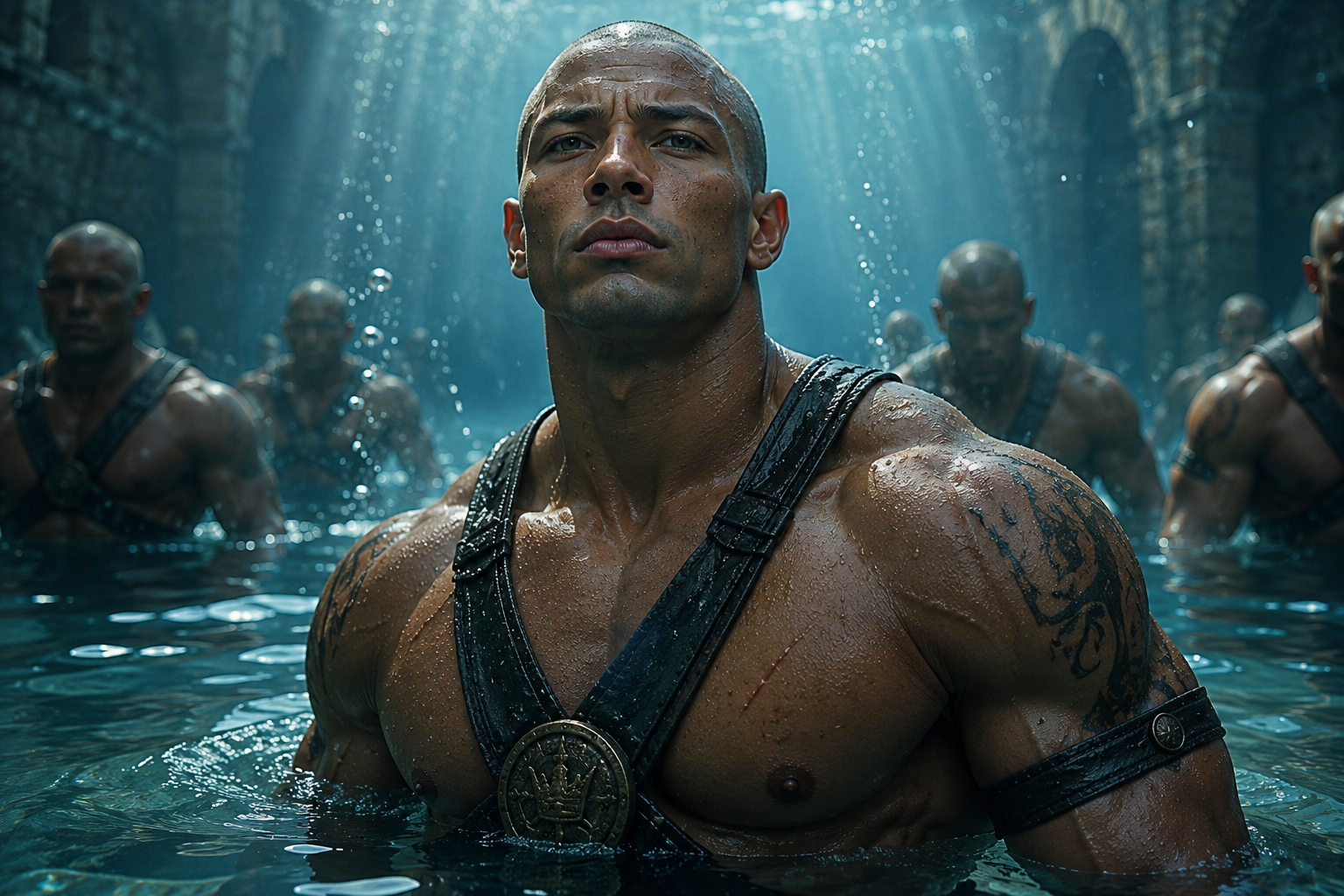
Fulfillment.
To march beside Velther was to remember why they had sworn the oath in the first place.
Yet years passed without battle.
Sartonia stood secure beneath the Sapphire Crown, and the kingdom's enemies remained distant rumors carried by merchants and sailors. Patrols replaced campaigns. Training replaced war. For many soldiers, the endless routine became tedious.
For Velther, it was enough. A soldier's duty was not to seek war, but to be ready when it came.
It was during these peaceful years that Velther formed the closest thing he had ever known to friendship.
The unit's field medic was an unassuming man whose talents lay not in taking lives, but in preserving them. He watched the company much as a blacksmith watches his finest tools, always knowing which blade required attention before it failed.
Before long, his attention settled almost entirely on Velther.
He saw what others saw.
If Velther was wounded, the company slowed.
If Velther was absent, confidence faltered.
If Velther were ever lost, something far greater than a single soldier would disappear.
So the medic made it his quiet mission to ensure that never happened.
He was always nearby after long marches, treating blisters before they became injuries, stitching cuts before they worsened, insisting Velther eat, drink, and rest whenever the opportunity arose. Velther rarely understood the concern, but he accepted it without argument.
As years passed and promotions followed, their assignments changed together.
Whenever Velther received orders to another company, the medic somehow found himself transferred shortly afterward. The arrangement became so common that few questioned it.
Eventually, Velther's reputation reached the highest levels of Sartonia's military.
He was selected for one of the kingdom's most elite special operations units, warriors entrusted with missions beyond the reach of conventional armies. They would infiltrate hostile territory, gather intelligence, eliminate critical threats, and disappear before anyone realized they had ever been there.
The assignment was considered one of the greatest honors a soldier could receive.
Velther accepted it without pride.
Still, he found himself missing the familiar rhythm of serving among hundreds of brothers in arms. Elite companies demanded silence where regular soldiers had shared laughter. Small teams left little room for the quiet camaraderie he had slowly learned to value.
It was a different kind of service.
Then, without warning, peace ended.
It began before sunrise.
A deafening roar echoed across Sartonia as buildings collapsed into clouds of stone and crystal dust. Screams spread through the streets faster than the smoke. Bells rang from every district as frightened citizens fled in every direction.
The attack had not come from beyond the kingdom's borders.
It had come from within.
The city's defenders responded with astonishing speed. Local guards and military patrols hunted the intruders through the streets, and before the sun reached its height, the violence was over.
The attackers lay dead.
Yet victory brought no comfort.
No banners identified the enemy.
No prisoners survived questioning.
No kingdom claimed responsibility.
For the first time in generations, the people of Sartonia looked upon their own streets and realized an impossible truth.
The Sapphire Kingdom was no longer untouchable.
Someone had found a way inside.
And somewhere beyond the horizon, whoever had sent them was surely preparing to return.
Chapter Three: First Combat
Peace had ended. Within days of the attack upon Sartonia, the Sapphire Crown declared war—not upon a kingdom, nor a ruler, nor a banner, but upon an idea.
Military intelligence had traced the ideology responsible for the attacks to a distant land beyond Sartonia's borders. Few soldiers had ever seen the region. Most knew it only from faded maps and lessons taught during childhood.
Velther knew nothing of it. Nor did he ask. Where Sartonia pointed, he would go.
The army's endless years of training suddenly gained purpose. Supplies were gathered, ships assembled, and thousands of soldiers boarded transports bound for foreign shores.
The voyage lasted days.
When they finally arrived, Sartonia established forward operating bases inside a neighboring nation whose leaders had neither declared war nor welcomed them with hostility. Diplomacy remained intact. The true enemy was believed to operate beyond the mountains, hidden among scattered settlements where the ideology had taken root.
The mission was simple. Destroy the movement before it could spread. Avenge those who had already fallen.
Although Sartonia possessed one of the finest trained armies in the world, it suffered from a quiet weakness: Almost no one had ever fought a war.
Its officers had earned promotions through years of exceptional service, flawless inspections, rigorous exercises, and unwavering discipline.
Its soldiers were veterans of training, but beginners in battle. No living commander truly knew how men would react when death arrived without warning.
Velther's special reconnaissance team became one of the first units sent into hostile territory.
Their orders were clear.
- Observe.
- Count enemy numbers.
- Identify leaders.
- Report.
- Do not engage.
The missions were successful. Information poured back to headquarters. Not a single soldier was lost. Yet every patrol left Velther feeling increasingly restless.
He had not crossed an ocean to watch others fight.
For the first time in his military career, he questioned an order. Respectfully. Firmly.
He requested reassignment. Not to another elite unit. To the infantry. He wanted to stand where Sartonia stood.
His request surprised his commanders, but it was approved.
When Velther arrived at his new company, a familiar face was already waiting.
The field medic. Somehow, as always, the transfer orders had found him too.
Neither man questioned it.
The campaign advanced. Temporary camps became fortified positions. Fortified positions became permanent operating bases.
Each day the companies ventured farther into the rugged mountain valleys, patrolling villages, escorting supply caravans, and searching for those responsible for the attacks.
Days passed without incident. Until one morning.
The patrol wound its way through a narrow mountain range. Jagged stone walls rose on either side while loose rock shifted beneath every step. There were no trees. No grass. Only the cold, wind and stone.
A soldier near the front suddenly collapsed. At first Velther thought the young man had simply lost his footing.
Then he noticed something unsettling. The body slid silently down the slope.
There was no attempt to catch himself. No cry. No movement.
Life had already left him.
Another soldier fell moments later.
Then another.
Still no one heard the enemy. There were no war cries. No marching feet. Only confusion.
Instinct seized the patrol. Men dove behind boulders. Others disappeared into a nearby cave.
Every eye searched desperately for an enemy no one could find.
Velther did not hide. He knelt beside a weathered stone and studied the battlefield. Three dead. All had fallen in nearly the same direction. The arrows had entered from similar angles. The terrain narrowed toward the western ridge.
Years spent studying maps, formations, and battlefield geometry assembled the answer almost instantly. West. He slowly rose to confirm it. Standing beside him was the medic. Neither spoke. Words would only waste time. Velther had already decided.
He charged. Not recklessly. Purposefully.
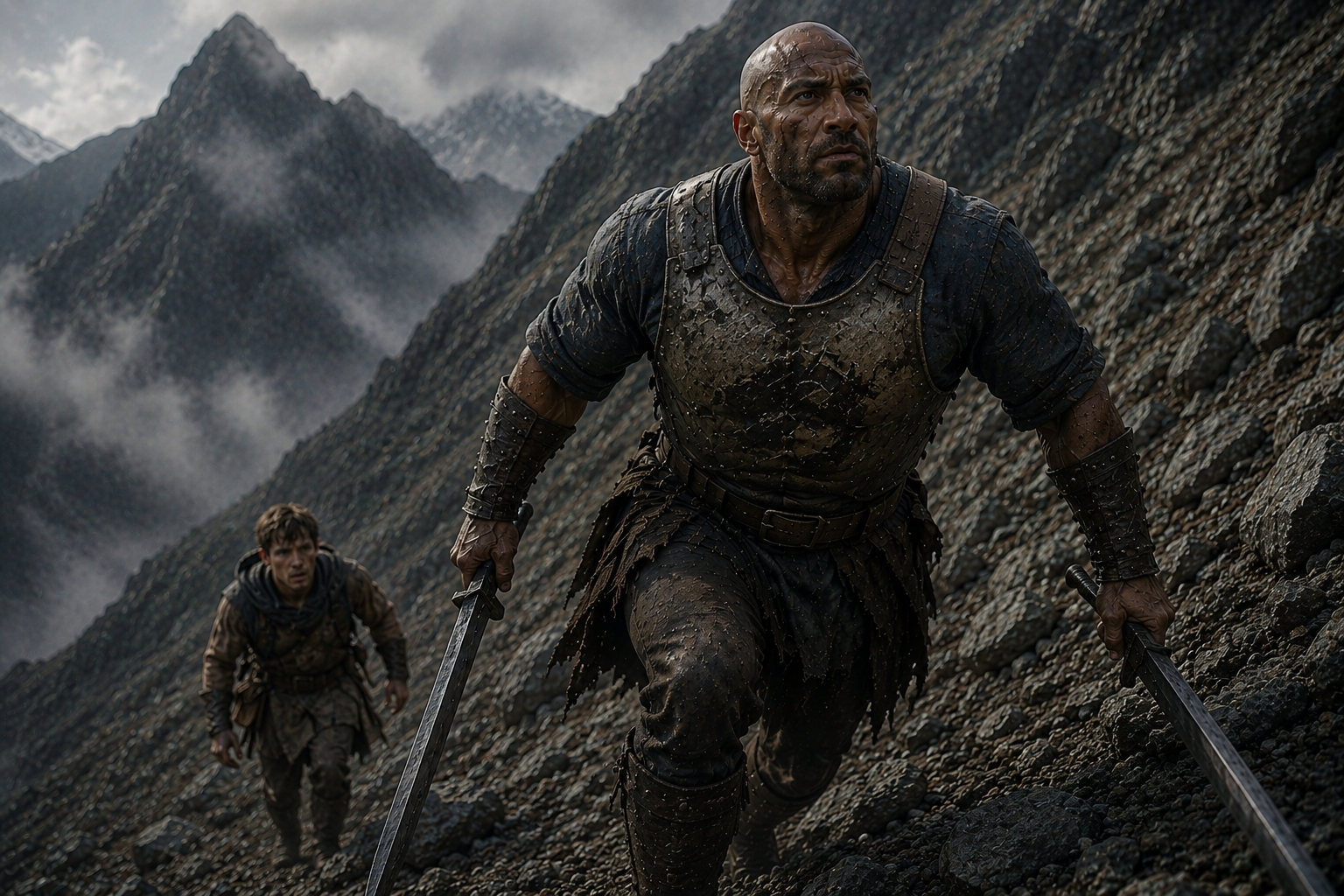
He angled toward the western slope, using broken stone as cover while closing the distance faster than the hidden archers expected.
Something changed inside him. The world became strangely calm. Every movement sharpened. Every sound separated itself from the next. Time did not race. It slowed. Fear never arrived.
Where others saw chaos, Velther saw opportunity. Where others saw death, Velther saw the path to victory. He became exactly what years of hardship had forged him to be - a predator.
The enemy never expected an assault. Their ambush had been carefully planned to pin the patrol in place until reinforcements arrived. Instead, one soldier reached them before they could react.
Steel met flesh. The first warrior fell before drawing another arrow. The second barely turned before Velther's blade found him. The fighting became desperate. Close. Brutal.
There was no hatred in Velther's strikes. No rage. No pleasure. Only purpose.
Each movement existed to remove another threat to Sartonia.
The medic remained only steps behind him, dragging the wounded from danger, binding cuts as quickly as they appeared, refusing to allow Velther's momentum to falter.
Within minutes… It was over. The ambush had been broken.
The rest of the company slowly emerged from cover. Some stared silently at the bodies. Others admitted they had never even seen where the attack had come from. Many could not understand how one man had reached the enemy before anyone else had even begun returning fire.
Velther understood something else entirely. Today Sartonia had won, but Sartonia had also been exposed.
Its soldiers knew discipline, courage and obedience. Few knew how to fight.
Peace had taught them to survive inspections while war demanded something different.
Mass. Audacity. Simplicity. Those lessons would have to be learned quickly.
Before the company departed, Velther personally oversaw the recovery of the fallen. Three young soldiers. Barely old enough to wear the uniform. He had scarcely known their names. Yet they had stood their ground when Sartonia called. That alone made them worthy of honor.
Their bodies were wrapped with the dignity reserved for heroes and prepared for the long voyage home. Velther believed they deserved nothing less.
Stories spread faster than official reports. Soldiers claimed Velther had charged an entire company alone. Some swore he had slain twenty warriors. Others insisted it had been thirty. Within weeks, taverns throughout Sartonia spoke of fifty.
The truth no longer mattered. A legend had begun. High Command took notice. Soon new orders arrived. Velther would once again leave his company. This time, not for reconnaissance. Not for surveillance.
He was assigned to Sartonia's most aggressive strike force—a unit entrusted with impossible missions, decisive assaults, and battles capable of changing the course of the war itself.
Velther accepted the orders with the same words he had spoken since taking his oath.
"I serve."
Chapter Three: First Combat
Peace had ended. Within days of the attack upon Sartonia, the Sapphire Crown declared war—not upon a kingdom, nor a ruler, nor a banner, but upon an idea.
Military intelligence had traced the ideology responsible for the attacks to a distant land beyond Sartonia's borders. Few soldiers had ever seen the region. Most knew it only from faded maps and lessons taught during childhood.
Velther knew nothing of it. Nor did he ask. Where Sartonia pointed, he would go.
The army's endless years of training suddenly gained purpose. Supplies were gathered, ships assembled, and thousands of soldiers boarded transports bound for foreign shores.
The voyage lasted days.
When they finally arrived, Sartonia established forward operating bases inside a neighboring nation whose leaders had neither declared war nor welcomed them with hostility. Diplomacy remained intact. The true enemy was believed to operate beyond the mountains, hidden among scattered settlements where the ideology had taken root.
The mission was simple. Destroy the movement before it could spread. Avenge those who had already fallen.
Although Sartonia possessed one of the finest trained armies in the world, it suffered from a quiet weakness: Almost no one had ever fought a war.
Its officers had earned promotions through years of exceptional service, flawless inspections, rigorous exercises, and unwavering discipline.
Its soldiers were veterans of training, but beginners in battle. No living commander truly knew how men would react when death arrived without warning.
Velther's special reconnaissance team became one of the first units sent into hostile territory.
Their orders were clear.
- Observe.
- Count enemy numbers.
- Identify leaders.
- Report.
- Do not engage.
The missions were successful. Information poured back to headquarters. Not a single soldier was lost. Yet every patrol left Velther feeling increasingly restless.
He had not crossed an ocean to watch others fight.
For the first time in his military career, he questioned an order. Respectfully. Firmly.
He requested reassignment. Not to another elite unit. To the infantry. He wanted to stand where Sartonia stood.
His request surprised his commanders, but it was approved.
When Velther arrived at his new company, a familiar face was already waiting.
The field medic. Somehow, as always, the transfer orders had found him too.
Neither man questioned it.
The campaign advanced. Temporary camps became fortified positions. Fortified positions became permanent operating bases.
Each day the companies ventured farther into the rugged mountain valleys, patrolling villages, escorting supply caravans, and searching for those responsible for the attacks.
Days passed without incident. Until one morning.
The patrol wound its way through a narrow mountain range. Jagged stone walls rose on either side while loose rock shifted beneath every step. There were no trees. No grass. Only the cold, wind and stone.
A soldier near the front suddenly collapsed. At first Velther thought the young man had simply lost his footing.
Then he noticed something unsettling. The body slid silently down the slope.
There was no attempt to catch himself. No cry. No movement.
Life had already left him.
Another soldier fell moments later.
Then another.
Still no one heard the enemy. There were no war cries. No marching feet. Only confusion.
Instinct seized the patrol. Men dove behind boulders. Others disappeared into a nearby cave.
Every eye searched desperately for an enemy no one could find.
Velther did not hide. He knelt beside a weathered stone and studied the battlefield. Three dead. All had fallen in nearly the same direction. The arrows had entered from similar angles. The terrain narrowed toward the western ridge.
Years spent studying maps, formations, and battlefield geometry assembled the answer almost instantly. West. He slowly rose to confirm it. Standing beside him was the medic. Neither spoke. Words would only waste time. Velther had already decided.
He charged. Not recklessly. Purposefully.
He angled toward the western slope, using broken stone as cover while closing the distance faster than the hidden archers expected.
Something changed inside him. The world became strangely calm. Every movement sharpened. Every sound separated itself from the next. Time did not race. It slowed. Fear never arrived.
Where others saw chaos, Velther saw opportunity. Where others saw death, Velther saw the path to victory. He became exactly what years of hardship had forged him to be - a predator.
The enemy never expected an assault. Their ambush had been carefully planned to pin the patrol in place until reinforcements arrived. Instead, one soldier reached them before they could react.
Steel met flesh. The first warrior fell before drawing another arrow. The second barely turned before Velther's blade found him. The fighting became desperate. Close. Brutal.
There was no hatred in Velther's strikes. No rage. No pleasure. Only purpose.
Each movement existed to remove another threat to Sartonia.
The medic remained only steps behind him, dragging the wounded from danger, binding cuts as quickly as they appeared, refusing to allow Velther's momentum to falter.
Within minutes… It was over. The ambush had been broken.
The rest of the company slowly emerged from cover. Some stared silently at the bodies. Others admitted they had never even seen where the attack had come from. Many could not understand how one man had reached the enemy before anyone else had even begun returning fire.
Velther understood something else entirely. Today Sartonia had won, but Sartonia had also been exposed.
Its soldiers knew discipline, courage and obedience. Few knew how to fight.
Peace had taught them to survive inspections while war demanded something different.
Mass. Audacity. Simplicity. Those lessons would have to be learned quickly.
Before the company departed, Velther personally oversaw the recovery of the fallen. Three young soldiers. Barely old enough to wear the uniform. He had scarcely known their names. Yet they had stood their ground when Sartonia called. That alone made them worthy of honor.
Their bodies were wrapped with the dignity reserved for heroes and prepared for the long voyage home. Velther believed they deserved nothing less.
Stories spread faster than official reports. Soldiers claimed Velther had charged an entire company alone. Some swore he had slain twenty warriors. Others insisted it had been thirty. Within weeks, taverns throughout Sartonia spoke of fifty.
The truth no longer mattered. A legend had begun. High Command took notice. Soon new orders arrived. Velther would once again leave his company. This time, not for reconnaissance. Not for surveillance.
He was assigned to Sartonia's most aggressive strike force—a unit entrusted with impossible missions, decisive assaults, and battles capable of changing the course of the war itself.
Velther accepted the orders with the same words he had spoken since taking his oath.
"I serve."
Chapter Four: The Two Percent
Among Sartonia's warriors, there existed an old saying inspired by the philosopher Heraclitus.
"Out of every hundred soldiers, marched to war. Ten are completely unprepared; eighty are just targets, eight legitimately fight and the other two... Those top two percent carry the burden of ninety-five percent of the killing. Yet among even those warriors, there is always one—the one who brings the others home."
Few believed the saying literally. Every soldier hoped to become part of the two percent. None claimed to be the one. Velther never gave the words much thought. He simply continued serving.
His reassignment came quietly. No ceremony. No promotion. No celebration. A single parchment bearing new orders arrived before sunrise. He was to report immediately to the Black Spear Detachment.
His new team consisted of only six soldiers.
Their commander was already regarded throughout the expeditionary force as a legend. Unlike the officers promoted during years of peace, this man had earned every scar in battle. He spoke little, expected perfection, and accepted nothing less.
When Velther arrived, the commander studied him only briefly.
"So you're the one they keep talking about." Velther saluted. "I serve." The commander gave a faint nod. "We'll see."
Training with the Black Spear differed from anything Velther had known.
There were no grand formations. No marching columns. No inspections. Every movement had purpose. Every conversation ended with a contingency. Every contingency had another contingency. A single mistake could doom the entire mission.
The commander often repeated the same lesson.
"We exist so others don't have to." He never glorified killing. He treated it as an unpleasant necessity. "If six of us do our job correctly.. .six hundred others go home."
Velther understood.
The detachment hunted people rather than armies. Generals. Financiers. Tribal chiefs. Couriers. Propagandists.
The men whose words inspired thousands to take up arms. The commander believed armies could always replace soldiers. Replacing ideas was far harder.
Cut away enough heads… Eventually the beast collapsed beneath its own weight.
Their next mission carried unusual urgency.
Military intelligence had uncovered the location of one of the movement's principal architects. Not its supreme leader. But one of the men responsible for spreading its poisonous ideology across the region. More troubling still...
He was hiding openly inside a settlement long believed friendly to Sartonia. Months of intelligence had failed to uncover him. Now they finally had their chance. The strike would be swift.
A chariot would carry the team into the city shortly after dawn. Four warriors would breach the building. Neutralize the guards. Capture the target alive. Two would remain outside. One to secure the horses. One to repel any pursuit.
Being the newest member of the detachment, Velther received the less glamorous assignment. The horses. He accepted it without complaint. Trust was earned. Not issued.
Morning fog drifted through the streets as the chariot rolled toward its destination. Everything appeared ordinary. Merchants prepared stalls. Children carried water. Other wagons crossed nearby intersections. Nothing suggested danger.
The team dismounted. Armor caught the morning light. Hands settled naturally upon sword hilts. Each warrior moved toward his assigned position. Months of rehearsal. Seconds from execution.
The commander stepped toward the doorway. Three arrows struck him almost simultaneously. One. Two. Three. Each buried itself deep into his chest. He never cried out.
He simply collapsed. Life left him before his body touched the stone.
Everything stopped. The breach team stared in disbelief. Their commander… The man who had survived impossible missions… Lay dead before taking a single step through the doorway.
The assault dissolved. Three elite warriors instinctively pulled back behind the chariot. Searching. Thinking. Waiting. For new orders. There would be none.
Velther looked toward the smallest soldier assigned beside him. "Follow me." He drew his blades and charged. Arrows hissed through the air. One slammed into his breastplate hard enough to stagger him before glancing harmlessly aside.
Velther never slowed. He crashed through the entrance. Inside, four bodyguards scrambled towards him. Too late. Steel flashed. The first fell before clearing his scabbard.
The second met Velther head-on and collapsed moments later. The remaining two fought desperately. Neither survived. Silence returned as suddenly as it had vanished.
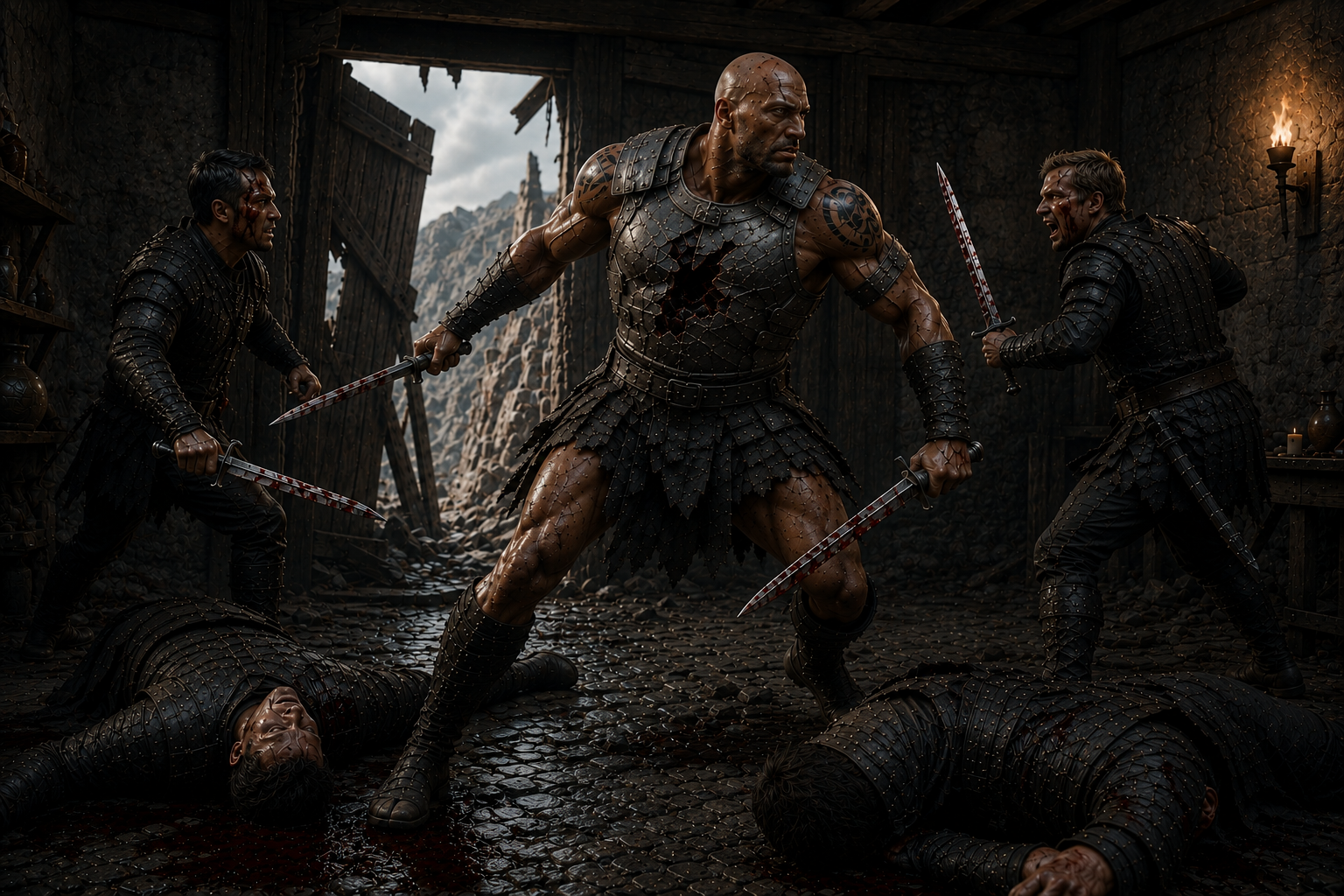
Breathing heavily, Velther turned toward the mission's objective. A frightened man lay on the floor. Unarmed. Shaking uncontrollably. This was no battlefield champion. No towering warlord. No master swordsman. He was simply a man whose words had convinced others to die.
Velther grabbed him by the collar. Only then did he realize… No one had followed. He stood alone.
Dragging the prisoner outside, Velther finally broke the paralysis gripping the others. The surviving members rushed into motion. The commander's body was lifted gently into the waiting chariot.
The prisoner was bound. The horses turned. Within moments the detachment disappeared back into the morning mist. The city scarcely understood what had happened.
The mission was declared a success. An architect of the uprising had been captured alive. Important intelligence followed. Future operations became possible. Hundreds of soldiers would never fight battles that otherwise would have been necessary.
Yet Velther remembered only one thing. The commander. During the debriefing, no one asked why the assault had faltered. No one asked why Velther had entered alone. Rumors already answered those questions differently with every telling.
Velther did nothing to correct them. Nor did he mention that seasoned veterans had frozen when their leader fell. Instead he spoke only of the commander's courage.
- "He led from the front."
- "He accepted the greatest risk."
- "He died exactly as he lived."
Velther believed every word. The commander had not failed. He had simply met an enemy who was faster. There was no shame in that. Only sacrifice.
In the weeks that followed, Velther found himself thinking less about the assault… and more about the arrows. No amount of courage could outrun them. No warrior, no matter how skilled, could cut down an enemy he never saw.
For the first time, Velther began to understand the vision of Francesca. Strength alone would not secure Sartonia's future. The wars ahead would not always be won by the strongest swords.
They would be won by those who could see farther...Strike first… Build better armor… Design better machines...
And spare the next generation from dying before they ever had the chance to fight. If invention could save even one young soldier from sliding lifeless down a mountainside… Then invention was worthy of the Sapphire Crown.
Years later, soldiers would speak of that mission differently. Some claimed Velther had stormed the house alone against impossible odds. Others insisted he had rescued the entire detachment after its commander fell. Those who had actually been there rarely corrected the stories.
Because the part they remembered most wasn't the fighting. It was the moment when six elite warriors became five… and one warrior brought the others home.
Chapter Five: Present Day
The war eventually ended.
Not with a final battle. Not with unconditional surrender. Not even with peace. The head of the movement had finally been found and slain, its leadership scattered across distant lands. The organized resistance collapsed soon afterward, allowing Sartonia's armies to return home victorious.
Yet victory felt strangely incomplete. Sartonia had won every battle that mattered. But the ideology had survived. It merely waited. Hidden. Patient. Waiting for another generation willing to listen.
Both sides quietly claimed victory. One had conquered the battlefield. The other had endured. Velther often wondered which mattered more.
The people of Sartonia cared little for such questions. Their heroes had returned. Ships crowded the harbor carrying thousands of soldiers back across the Sapphire Sea. Streets overflowed with cheering crowds. Children waved blue banners from rooftops while church bells rang throughout the kingdom.
Among all those returning… One name rose above the others. Velther. Stories of impossible victories had reached Sartonia long before he ever did. The man who broke mountain ambushes. The warrior who stormed enemy strongholds alone. The soldier who always came home.
Children pretended to be him during their games. Veterans saluted him before he could salute them. Even nobles lowered their voices when he entered a room. The legend had become larger than the man.
King Aurelion welcomed him personally. The entire Royal Court assembled beneath the Sapphire Throne as Velther approached wearing the same scarred armor he had carried through the war.
He knelt as he always had. Velther lowered his head.
"I kneel before my king."
Aurelion smiled.
"And that is why you rise above princes."
The king descended from his throne and stood before the assembled court.
"My blood has guarded Sartonia for generations."
He placed a hand upon Velther's shoulder.
"But blood alone does not make royalty."
He looked toward the nobles.
"The title of prince has always belonged to my family."
Then toward Velther.
"Today it belongs to the man who has served Sartonia more faithfully than any son I could ever have."
Silence filled the chamber.
"Rise..."
Aurelion declared.
"Velther, Returning Prince of the Sapphire Crown."
The hall erupted. Some nobles hesitated. Others applauded immediately. The people never questioned it. From that day forward, Velther possessed no royal blood… Yet all of Sartonia called him Prince.
His next assignment surprised him. High Command no longer wanted Velther leading assaults. They wanted him planning them. Strategy. Doctrine. Training. Intelligence. The work was important. Necessary. He hated every moment of it. Maps could never replace mountains. Meetings could never replace marching beside soldiers.
He missed the smell of rain before battle. The weight of armor. The quiet conversations shared around campfires. Most of all… He missed the company of the old field medic.
Years earlier the medic had retired from service. He now lived peacefully with a wife and children not far from Sartonia's western canals. Velther visited whenever duty allowed. Watching children laugh around the dinner table stirred unfamiliar thoughts.
He had spent his life protecting families. He had never imagined having one. What would he even say to a child? How could a man who understood only war teach someone how to live?
The questions lingered long after each visit.
Age eventually reached even Velther. Not suddenly. Gradually. A shoulder that no longer healed completely. Old arrow wounds that ached before storms. Scars that tightened each winter. The people called him immortal. Velther knew better. Every scar carried a memory. Every wound reminded him that someday...One would not heal.
King Aurelion understood that as well. He refused every request Velther submitted to return to active combat.
- "If you fall," the king said quietly, "our enemies will celebrate more than a battlefield victory."
- "They will convince the world that hope itself can die."
- "You have become more than a soldier."
- "You have become Sartonia."
Velther never argued again.
Politics gradually filled the empty space left by war. It was there that Velther finally met Francesca. He had known her only through reports. The brilliant engineer. The inventor whose machines had saved countless lives. The royal scholar forever arguing that steel alone could no longer defend the kingdom.
Meeting her proved... unexpected. She was striking. Confident. Brilliant. Her mind raced faster than most conversations could keep pace. She challenged generals without hesitation. Corrected ministers when they were wrong. Debated the king as though speaking to an equal.
Velther had never met anyone quite like her.
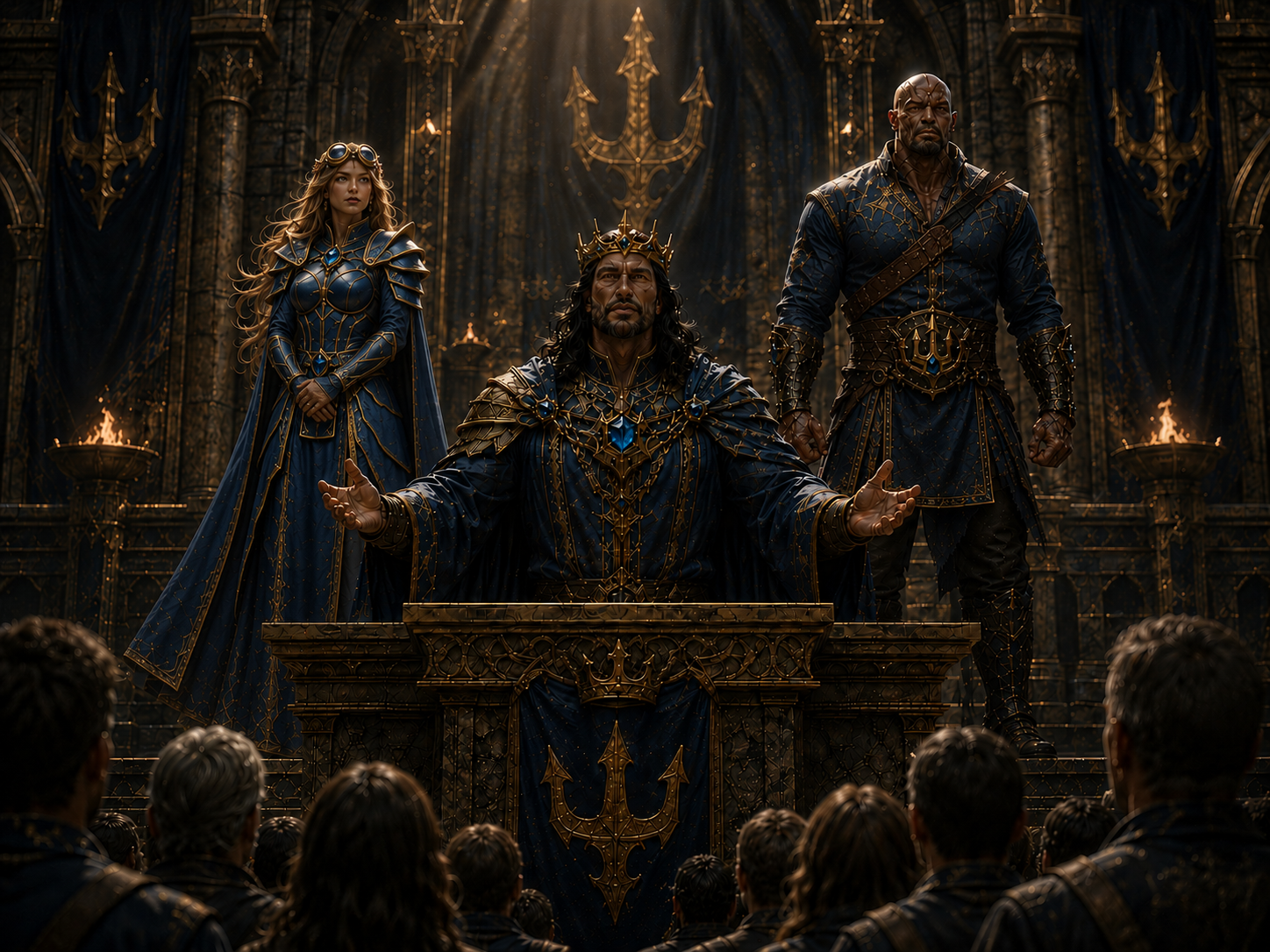
The people noticed them together almost immediately. Whenever royal councils gathered, so too did curious eyes. The kingdom's favorite prince. The kingdom's brightest noblewoman. Whispers spread through marketplaces. Artists painted them standing side by side.
Writers invented romances that had never happened. Newspapers declared weddings only weeks away. Neither denied the rumors. Francesca found them amusing. Velther found himself wondering… What if they were true?
He began looking forward to council meetings. Listening more closely whenever she spoke. Remembering details she mentioned in passing. The books she preferred. The inventions that excited her. The problems she wished to solve. He studied Francesca with the same discipline he once devoted to mastering warfare.
Yet something troubled him. Whenever Francesca spoke of the future...She spoke of power. Power for Sartonia. Machines. Industry. Progress. A kingdom strong enough that no enemy would ever dare invade again. She dreamed of shaping history.
Velther admired that. Perhaps… He thought… She needed someone beside her. For the first time in his life… Velther imagined a future beyond war. He imagined Francesca standing beside the Sapphire Throne.
He imagined protecting not merely a kingdom… But a queen.
King Aurelion had no heir. Queen Morvessa had passed years earlier without bearing a child.
One day...Someone would inherit the Sapphire Crown. Francesca possessed one of the oldest royal bloodlines in Sartonia. The nobles spoke of it often. Velther scarcely noticed at first.
But over time… He grew accustomed to hearing another title attached to his own. Prince. Once the word embarrassed him. He had been born among laborers. Raised in poverty. Fed by public granaries. He was no prince.
Yet people insisted. Every parade. Every speech. Every newspaper. Every child who looked up at him. Prince.
Eventually… He stopped correcting them. Then came a thought that would have horrified the young soldier he once was. If Francesca became queen… Could he stand beside her?
Not for power. Not for wealth. Not even for glory. Simply… To make her happy.
It was an innocent dream. But dreams have a way of changing men. Velther had survived every enemy who had ever stood before him. He did not yet realize...
The greatest battle of his life had already begun. It would not be fought with swords.
It would be fought within his own heart.
Aurelion, The Sapphire King
Chapter One: The Sapphire Age
The destruction of the Shimmering Spire marked the end of one of the darkest chapters in Sartonian history. Though the Prophet's deception had been exposed, the cost was immense. Much of the city's Atlantean infrastructure lay in ruins, Domain Crystal networks had been shattered, and countless lives were lost in the chaos that followed. For the first time since its founding, the Whitesalt City faced the possibility that its greatest achievements might never be rebuilt.
King Wakian devoted himself not to conquest, but to recovery. While Francesca and Sartonia's scientists worked tirelessly to restore the Atlanteans and stabilize the city's technologies, Wakian focused on preserving the kingdom itself. Trade routes were reopened, homes rebuilt, and order gradually restored to a people still recovering from the horrors of the Spire.
Although progress returned, the burden of rebuilding weighed heavily upon the aging king. Before his passing, Wakian made one final decision that would shape the future of Sartonia.
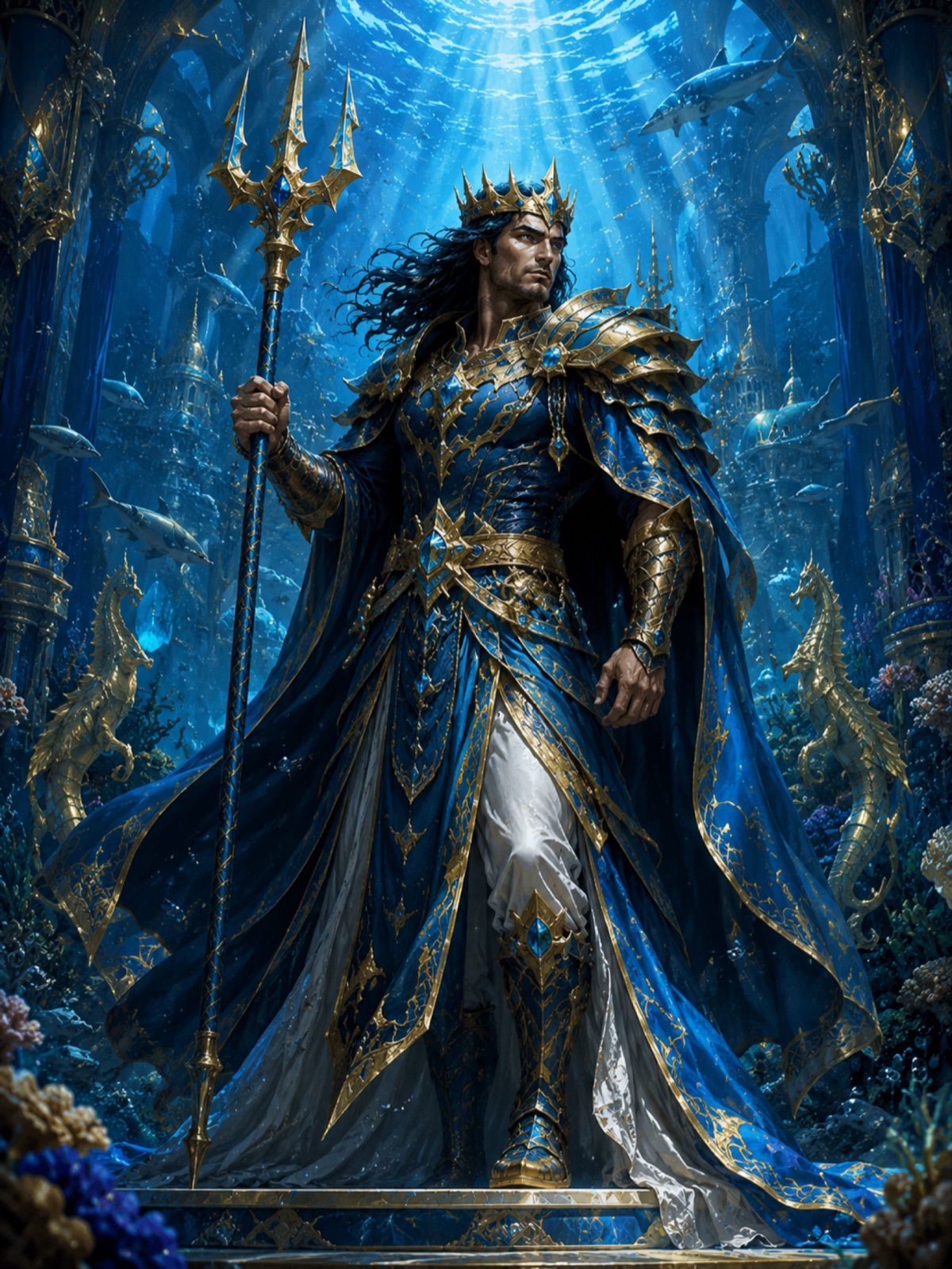
Rather than naming one of Sartonia's celebrated generals or war heroes, Wakian entrusted the Sapphire Crown to Aurelion, his Chancellor of Commerce and Civic Affairs. He believed the next chapter of Sartonia would not be won by the sword, but through wise governance, economics, diplomacy and order.
When King Wakian passed, the Sapphire Crown and the Trident of Tides were placed into Aurelion's hands.
The Age of Discovery had ended. The Sapphire Age was now beginning.
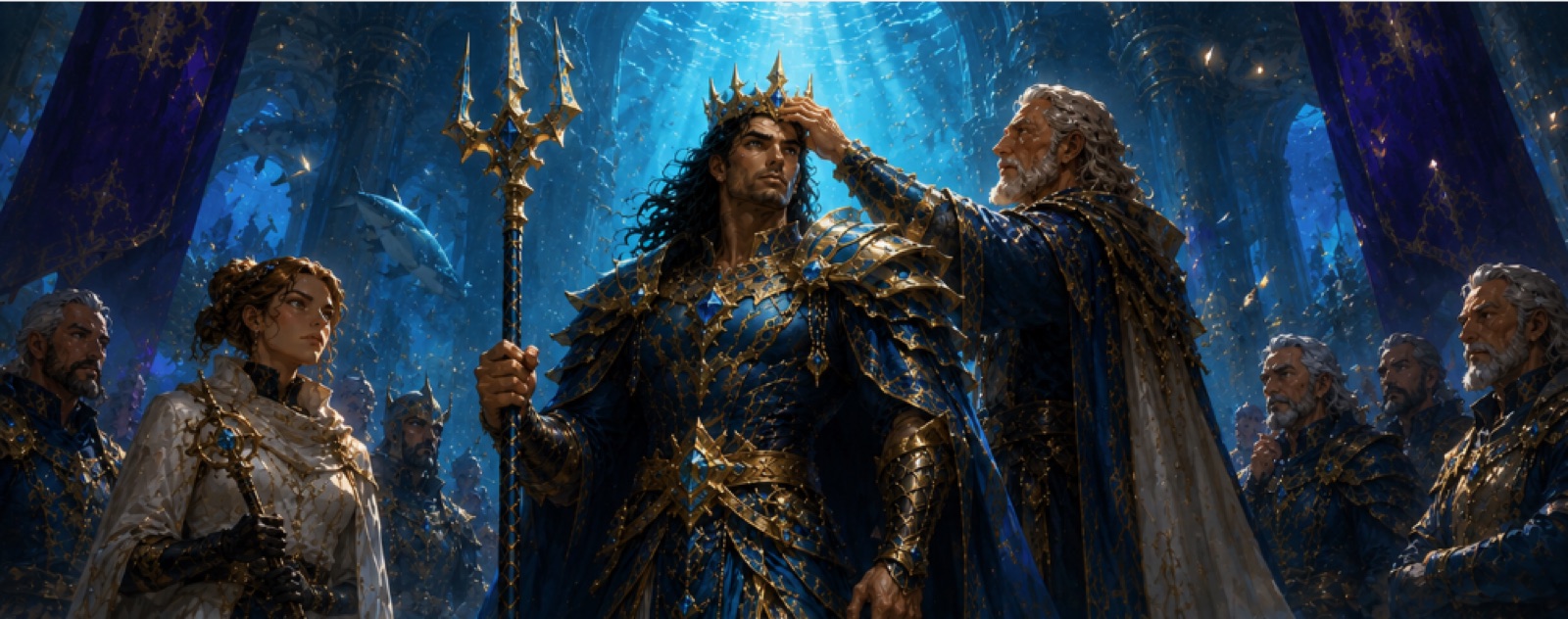
Upon ascending to the Sapphire Throne, King Aurelion inherited a kingdom still recovering from the devastation left by the Shimmering Spire. While many among the High Council urged a rapid military expansion to prepare for the next inevitable conflict, Aurelion saw a different path. He believed Sartonia's greatest strength was not its armies, but the ingenuity of its people. If the city was to become the beacon Wakian had envisioned, its future would be built through prosperity rather than perpetual war.
The Queen from Beyond the Sea
Not long after his coronation, as Sartonia began the difficult work of rebuilding, a lone traveler arrived at the Whitesalt City. Calling herself Morvesa, the young Nether woman had crossed the Shimmering Atlant with only a small boat and a curious companion known as Lady LD, who wore an aged seal bearing the insignia of Guardians. With Lady LD quite ill, Morvesa explained that she sought nothing more than medical care for her companion and hoped someone within the Sapphire Council might recognize the ancient symbol and reunite Lady LD with her Guardian tribe. Her journey, she said, was far from over.
The unusual pair quickly drew the attention of the royal court. Foreigners were not common within Sartonia, and a Nether woman was rarer still. Believing the matter worthy of the king's attention, the Sapphire Council arranged an audience before Aurelion. What began as a simple request for hospitality became something far greater. Aurelion found himself captivated not only by Morvesa's beauty, but by her quiet compassion and unwavering belief that people could choose creation over destruction. Though they came from worlds shaped by different customs, the two spoke as if they had known one another for years.
Their growing affection was met with fierce resistance. The Sapphire Council reminded Aurelion that no Atlantean monarch had ever taken a Nether as queen, warning that such a union would undermine the legitimacy of the Sapphire Dynasty and divide the kingdom. Aurelion rejected the argument outright. A king, he declared, could not preach unity while allowing prejudice to dictate his own heart.
Fearing the High Council would spend months rallying opposition, Aurelion ordered the ceremony to take place within days. The wedding was attended by only a handful of loyal councilors and royal witnesses before Morvesa was crowned Queen of Sartonia.
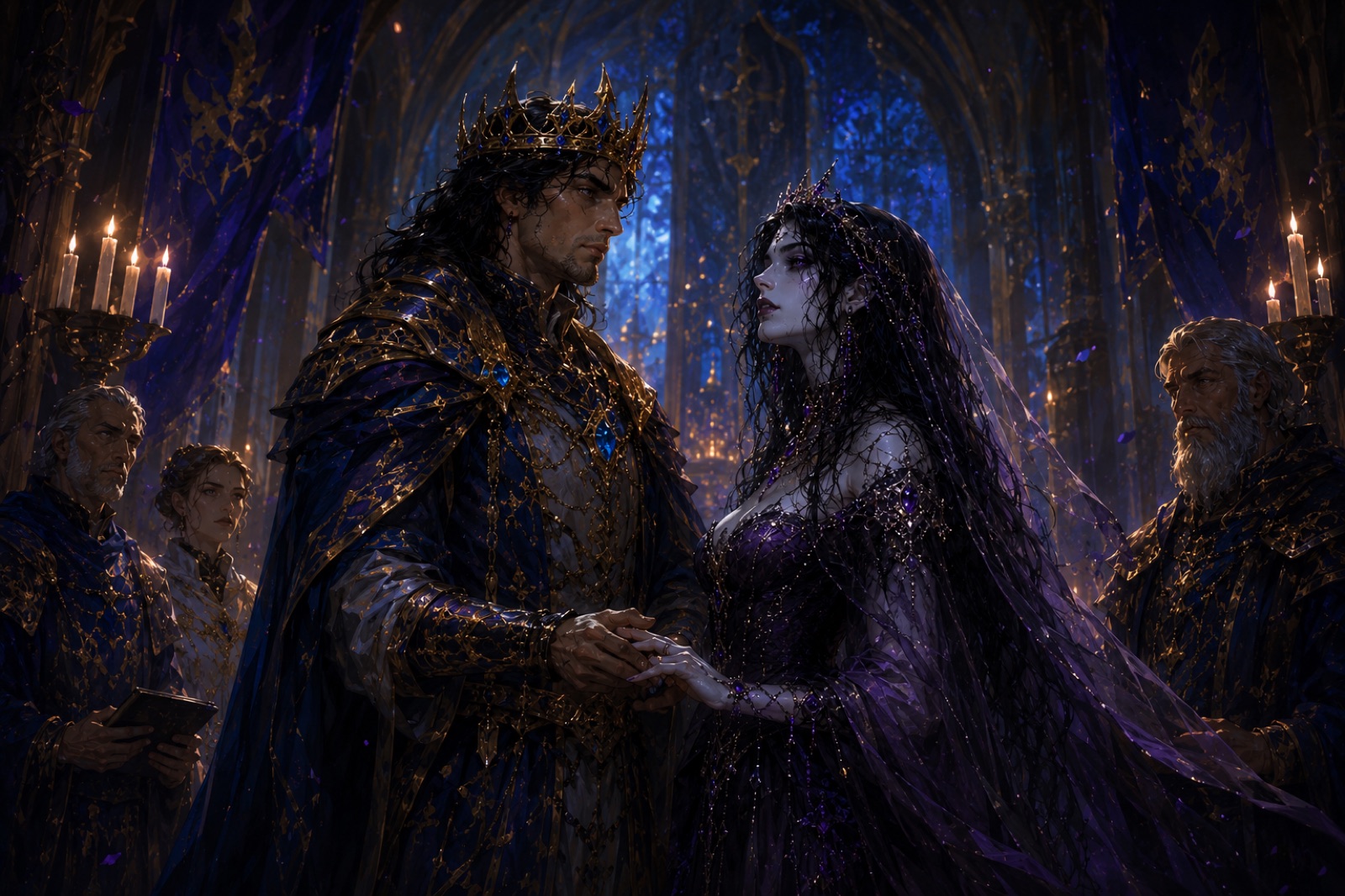
The marriage shocked the kingdom. Traditionalists denounced it as an affront to Atlantean heritage, while many common citizens struggled to accept a foreign queen. Yet Sartonia continued to prosper. Trade expanded, reconstruction accelerated, and the city's workshops hummed with innovation. The success of Aurelion's early reign gave him the political strength to withstand the outrage. Though resentment lingered beneath the surface, few could deny that the kingdom was growing stronger.
One of Aurelion's main initiatives was to commission Francesca and her engineers to begin adapting many of Sartonia's wartime inventions for peaceful purposes. Atlanteans once designed for military service were reimagined as builders, laborers, and explorers. Crystal-powered machines intended for siege and logistics were redesigned to construct harbors, restore infrastructure, and support trade throughout Eucos. Rather than measuring success by victories on the battlefield, Aurelion sought to make Sartonia indispensable through commerce, innovation, order and cooperation.
To many, the young king appeared naïve. Critics argued that wealth could never replace strength and warned that Sartonia's enemies would one day test his resolve. Aurelion never denied that day might come. He simply believed that seasons spent building bridges instead of battlefields made that day less likely.
The Kingdom of Valedorn
To the northeast of the Shimmering Atlant lies the Kingdom of Valedorn, a nation united in name yet fractured in practice. Though ruled by a single crown, much of the countryside remains under the control of powerful tribal chiefs, regional warlords, and hereditary clans who recognize the High King's authority only when it suits their interests. Endless border skirmishes, shifting alliances, and generations of civil conflict have left Valedorn economically stagnant despite its abundance of natural resources. To outsiders, it is a kingdom of laws on parchment but chaos in practice.
Its ruler, High King Aldric Thornvale, is feared across the continent. A brilliant battlefield commander, Aldric has preserved his throne through relentless military campaigns, crushing rebellion wherever it appears. Yet every victory leaves his treasury poorer and his kingdom no more unified than before. His armies can win battles, but they cannot build prosperity.
Recognizing an opportunity to stabilize both kingdoms, Aurelion invites Aldric to Sartonia to negotiate what would become the largest trade agreement in the city's history. Sartonia would export Atlantean engineering, Domain Crystal technologies, and repurposed Atlantean constructs designed for construction, infrastructure, order and commerce. In return, Valedorn would provide timber, iron, agricultural goods, and access to lucrative inland trade routes. After much negotiation, the Treaty of Whitesalt is signed, hailed by many as the beginning of a new era of cooperation.
The Treaty of Whitesalt was hailed as the first great diplomatic achievement of Aurelion's reign. Convinced that Sartonia had entered a new era, the young king directed Francesca and her engineers to complete the conversion of nearly every remaining Atlantean war construct into machines dedicated to construction, agriculture, trade, and order. Aurelion believed the age of siege engines had ended. The future belonged to builders, not conquerors.
Convoy after convoy departed Sartonia to great celebration. As promised, Valedorn received Atlantean construction machines, engineering expertise, and the knowledge to maintain them. Trade flourished, merchant vessels crossed the Shimmering Atlant in growing numbers, and for a brief time the treaty appeared to vindicate Aurelion's belief that commerce could accomplish what armies never could.
Months later, reports from Blackspear scouts and merchant captains painted a different picture. Communication from Valedorn had slowed, trade caravans had become increasingly guarded, and rumors spread of renewed fighting deep within the kingdom's interior. As reliable intelligence finally reached Sartonia, the truth became clear. High King Aldric had ordered the Atlantean machines retrofitted for war. Though Valedorn's soldiers struggled to master the sophisticated Atlantean constructs, the machines possessed such overwhelming engineering power that, even imperfectly employed, they shifted the balance of the civil war in Aldric's favor.
The revelation shook the High Council. Having committed fully to his vision of peace and order, Aurelion had already transformed Sartonia's own military industry into one of construction and commerce. The kingdom possessed few purpose-built war machines of its own, while those it had created now marched beneath another king's banner. To many of the elder councilors, it appeared the young monarch had allowed Sartonia's greatest technological advantage to become the instrument of another ruler's conquest. Quiet doubts soon became open criticism, and whispers spread throughout the council chambers that King Aurelion's faith in diplomacy and devotion to his Nether queen had blinded him to the realities of power.
Chapter Two: The King’s Declaration
Despite the troubling reports from Valedorn, life within Sartonia continued much as Aurelion had hoped. New harbors welcomed merchant vessels from distant shores. Domain-powered aqueducts carried fresh water to expanding districts, while Atlantean laborers raised homes faster than craftsmen alone ever could. The Sapphire Age had not unfolded exactly as the young king envisioned, but neither had it collapsed.
The council argued endlessly over Valedorn. Some demanded the treaty be dissolved immediately, while others insisted that abandoning trade would only strengthen the very warlords Aldric now sought to defeat. Aurelion chose patience. The Atlantean machines had already crossed the sea. Recalling them was impossible. If the kingdom was to preserve peace, it would have to do so through diplomacy rather than panic.
He would never learn whether that decision was right.
The bells began shortly after midnight.
Not the measured toll of ceremony, but the frantic fret reserved for invasion. Before the palace guards could determine the source, the eastern quarter erupted into flame. Moments later, another explosion shook the Whitesalt City as fire climbed the rooftops surrounding the Sapphire Palace. Screams echoed through the streets while columns of black smoke rose into the night sky.
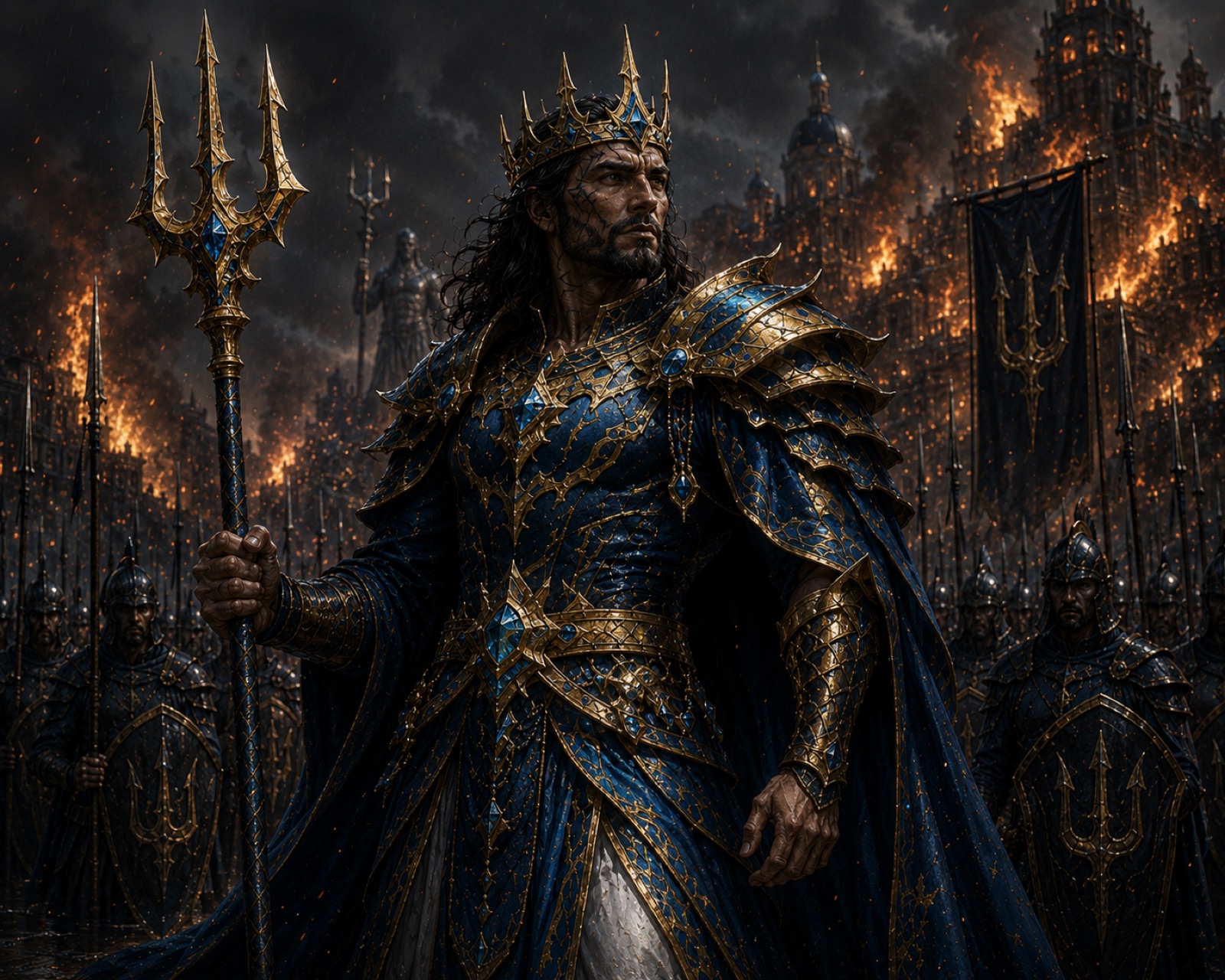
Aurelion wasted no time. Grasping the Trident of Tides, he descended from the palace with his royal guard and moved directly into the burning city. The king was no legendary warrior, but he would not watch from behind stone walls while his people bled. Throughout the night he directed evacuations, rallied frightened citizens, and organized the scattered city watch into defensive lines as Atlantean builders abandoned their tools to carry the wounded from collapsing buildings.
The attackers struck with discipline rather than numbers. Small groups appeared without warning, setting fires, murdering guards, and vanishing into the chaos before defenders could surround them. They carried no banners, wore no heraldry, and spoke little, leaving behind only bodies and burning streets. By dawn, every surviving assailant had either fallen in battle or escaped into the darkness beyond Sartonia's walls.
The attack had failed to break the city. But it had accomplished something far worse.
As the first light of morning crept across the harbor, Aurelion finally returned to the Sapphire Palace, expecting only to assess the damage left behind. Instead, he found the doors to the royal chambers shattered open.
Guards lay motionless in the corridor, their armor blackened by smoke and streaked with blood. The chamber beyond had been ransacked, furniture overturned and shattered glass scattered across the marble floor. A deafening silence filled the room where only hours before the queen had slept.
"Morvesa?"
There was no answer.
Aurelion moved deeper into the chamber, his pace quickening with every step until he saw her.
She lay upon the cold stone floor beneath the great window overlooking the Whitesalt City, her royal garments stained crimson. Though the battle outside had long since ended, the king fell to his knees beside her, refusing to believe what his eyes already knew. He took her hand in his own, hoping for warmth, for breath, for anything that might tell him she still lived.
There was nothing.
For a long while, the room remained silent save for the crackling of distant fires beyond the palace walls. Servants and guards gathered outside the doorway, none daring to enter. The king who had spent his reign building prosperity for others could do nothing for the one person he had failed to protect.
Only then did Aurelion notice something else. Lady LD was gone.
The companion who had never willingly left Morvesa's side had vanished without a trace. There were no signs of struggle beyond the shattered chamber, no body among the fallen, no witness who had seen where she had gone. Whether she had escaped, been taken, or still wandered somewhere within the burning city, no one could say.
As dawn broke over Sartonia, word spread quickly through the palace. The attackers had come without banners. They had spoken no names.
Every surviving assailant had either fallen in the assault or disappeared into the darkness before they could be captured.
The Queen of Sartonia was dead.
No one knew who had ordered the attack.
By midday, the High Council convened beneath the vaulted halls of the Whitesalt Palace. The smell of smoke still lingered in the chamber, carried in through shattered windows overlooking a city struggling to extinguish the last of the night's fires. The empty seat reserved for Queen Morvesa remained untouched.
No one questioned who the enemy might be.
"Valedorn."
The accusation came almost immediately.
"They possess our machines."
"They have already betrayed the Treaty of Whitesalt."
"They knew the High Council would soon demand the agreement be dissolved."
"They struck first."
Voices rose across the chamber until Aurelion quietly stood.
"A kingdom is not one man," the king said. "Nor is one man always master of his kingdom."
Silence returned. High King Aldric Thornvale was an obvious suspect. He had accepted Sartonian technology under the guise of rebuilding, only to convert it into engines of war. If the treaty collapsed, his military campaign would falter. Eliminating the queen and terrifying Sartonia into honoring the agreement—or provoking an invasion he could rally against—were both conceivable motives.
Yet another possibility troubled Aurelion even more.
Valedorn was fractured. Powerful warlords still commanded vast regions beyond the High King's direct control. Any one of them stood to gain by destroying the fragile relationship between Sartonia and the crown. If trade ended, Aldric would lose the technological advantage that was slowly unifying the kingdom. The civil war would continue, and the warlords would survive.
The room fell quiet as the implication settled over the council.
"If Aldric ordered this," Aurelion said, "then he has declared war upon Sartonia."
He looked slowly around the chamber.
"But if one of his rivals ordered it... then Morvesa was murdered to make us choose the wrong enemy."
No one spoke. For the first time, the High Council understood that the attack may not have been an act of vengeance. It may have been an act of manipulation.
The High Council reconvened three days after the attack. Though the fires had finally been extinguished, the smell of smoke still lingered throughout the Whitesalt Palace. The queen's funeral had yet to be held. There would be time to mourn later. First, the kingdom demanded answers.
This time, the chamber was not filled with speculation. It was filled with evidence.
Blackspear Intelligence had worked without rest since the night of the attack. Maps covered the council table. Captured weapons, coded correspondence, witness testimony, intercepted communications, and reports gathered from merchant caravans were laid before the king in painstaking detail. Piece by piece, the investigators reconstructed what they believed to be the origins of the conspiracy.
The conclusion appeared undeniable. The attack had not been orchestrated by High King Aldric nor by any single warlord of Valedorn.
It originated from a decentralized movement operating beyond Valedorn's eastern frontier—a radical ideology that had quietly spread among rival tribes, fractured settlements, and militant factions for years. Bound not by borders but by shared belief, its followers rejected every established authority, preferring fear and chaos over civilization and order.
The assassination of Queen Morvesa, the report concluded, had not been intended to conquer Sartonia. It had been intended to provoke it.
By murdering the queen and striking the Whitesalt City itself, the movement hoped to frighten the Sapphire Crown into abandoning trade with Valedorn altogether, depriving the High King of Atlantean technology and prolonging the civil war that had kept the frontier divided for generations.
The evidence was exhaustive. The conclusions were unanimous. Even the most skeptical members of the High Council found little reason to doubt the findings presented before them. Aurelion remained silent for a long while.
His eyes rested not upon the maps, nor the reports, but upon Morvesa's wedding band lying alone atop the council table. Finally, he rose.
"If this Ideology survives," he said quietly, "every nation that chooses peace will one day suffer what Sartonia has suffered."
The chamber remained still.
"We will not answer this crime by invading kingdoms that did not order it." His gaze swept across the council. "Nor will we stand idle while those responsible prepare another attack."
He placed both hands upon the table. "The Sapphire Crown declares war." Not upon Valedorn. Not upon Aldric Thornvale. Not upon any tribe or banner.
"We declare war upon the Ideology."
Chapter Three: The King’s War
For the first time since the founding of Sartonia, the kingdom would wage a war without seeking to conquer a nation.
Its purpose was direct: Find those responsible, destroy the movement, and ensure no other kingdom would awaken to the same grief that had consumed the Sapphire Crown. Unlike many kingdoms, Sartonia did not need to raise an army. It already possessed one.
Veterans of the Shimmering Spire assembled beside younger soldiers who had spent years training beneath them. Officers reopened campaign maps scarcely cold since the Dakla War, while the kingdom's quartermasters prepared once again for a campaign across the sea.
The army remained disciplined. Professional. Confident.
Yet beneath that confidence lay a truth few wished to acknowledge. The last great battles had been won alongside Francesca's Atlantean war machines. Since then, Aurelion had transformed nearly every surviving military construct into machines of commerce, agriculture, engineering, and construction.
The reforms had strengthened the kingdom. They had also changed the army. Now Sartonia prepared to fight another war… without the very machines upon which its previous victories had been built.
Francesca ordered the royal foundries to resume military production. The request proved far more difficult than expected. The assembly lines no longer produced engines of war. They built harbor cranes, Irrigation systems, Bridge supports, Mining equipment. The craftsmen remained. The crystal forges remained. The factories remained. But every tool, template, and production line had been redesigned for peace. These reforms could not be undone in a single season.
The first reports from the front arrived within weeks of the landings. King Aurelion insisted upon reading each one himself.
At first, there was little cause for concern.
Supply lines remained secure. Engineers established fortified encampments with remarkable speed, and the army advanced according to schedule. Sartonia's discipline, logistics, and organization surpassed nearly every force it encountered. Then came the battle reports.
Though each described a different engagement, together they revealed a troubling pattern.
Sartonian soldiers fought with courage and discipline. Formations held, commands were obeyed, and retreats were orderly. Yet the victories that had once defined Sartonia failed to materialize.
In previous wars, the kingdom's armies had fought alongside Francesca's Atlantean constructs. Towering war machines had shattered enemy lines, transported supplies across impossible terrain, breached fortifications, and absorbed the chaos that so often unraveled conventional armies. Sartonian infantry had been trained to fight in concert with these machines, their tactics evolving around the overwhelming technological advantage they provided.
Now those machines were gone. The constructs that once marched into battle now rebuilt bridges, harvested fields, dredged harbors, and restored cities. For the first time in living memory, Sartonia's army was being asked to wage war as every other kingdom did.
Steel against steel. Shield against shield. Man against man.
The transition proved far more difficult than anyone had anticipated.
Veteran tribal warriors exploited weaknesses that Atlantean constructs had once concealed. Ambushes that would have been broken by armored machines now trapped entire companies. Difficult terrain that Atlanteans once crossed with ease became exhausting obstacles for infantry alone. Battles that had once depended upon engineering superiority were now decided by instinct, improvisation, and hard-earned experience.
Night after night, Aurelion studied the dispatches until the same conclusion emerged from every report. The army had not become weaker. It had become different.
Sartonia had spent years perfecting a way of war that no longer existed.
The kingdom would adapt.
As the campaign entered its second month, royal messengers departed the Whitesalt City in every direction carrying sealed proclamations bearing the Sapphire Crown. They crossed mountains, sailed distant seas, and rode forgotten roads into kingdoms where no Sartonian banner had flown in generations.
The message was simple: The Sapphire Crown sought experience.
Veterans. Monster hunters. Scouts. Engineers. Mercenaries. Retired commanders.
Anyone whose life had been forged by war was invited to fight beneath Sartonia's banner.
The response surpassed every expectation. Some answered for gold. Others for glory. Many simply recognized that the wealth of Sartonia far exceeded anything another kingdom could offer.
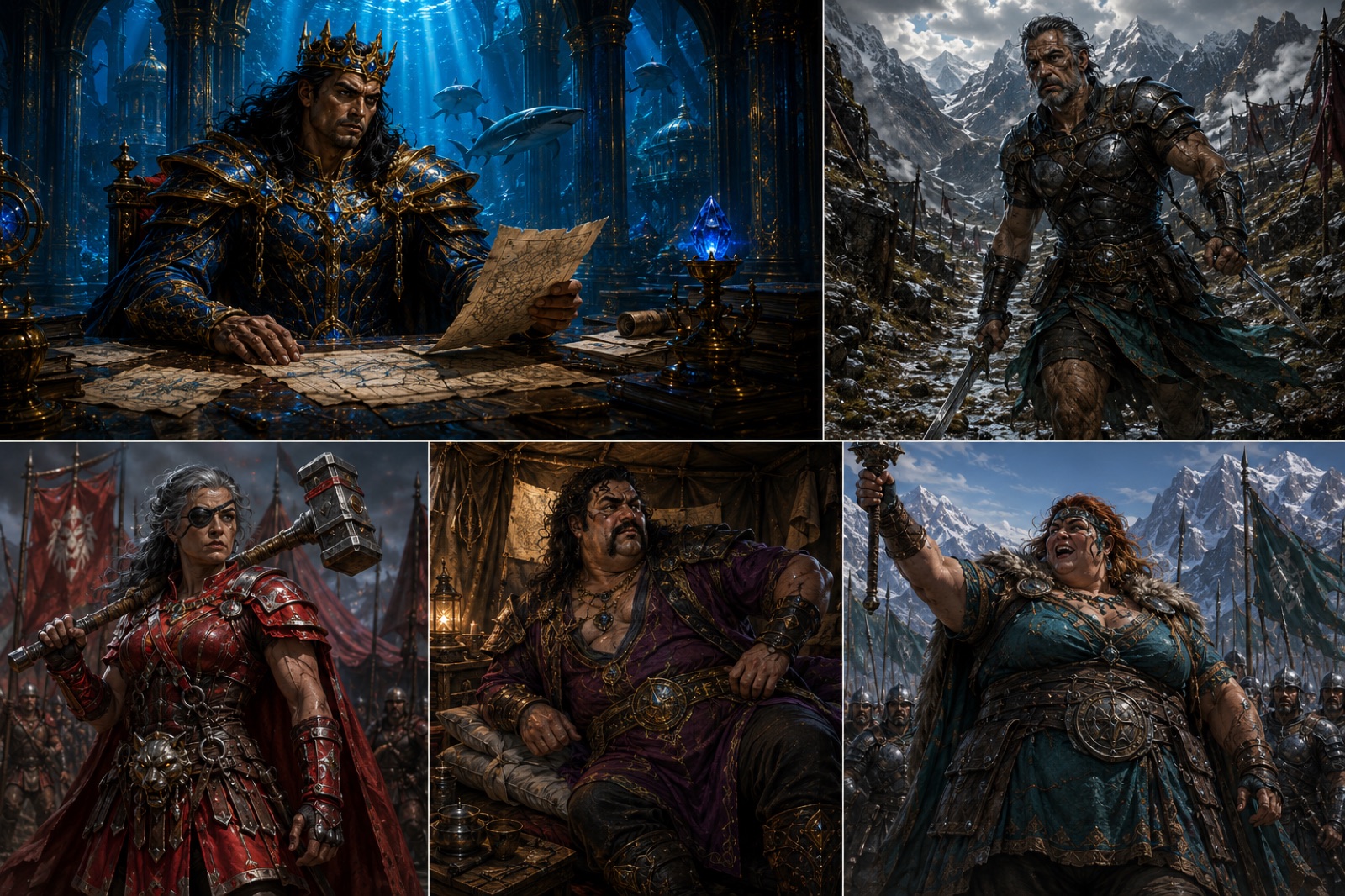
Among the first was Hydna, Veteran Raider, an aging commander whose body no longer possessed the strength of his youth, yet whose favor with the six gods remained the subject of endless speculation. Entire campaigns had turned upon his judgment alone, and few living commanders possessed greater battlefield experience.
Soon after came Reios, the Old Wolf, leading the remnants of the legendary Band of the Wolf. Cautious, patient, and relentless, Reios had survived more campaigns than many kingdoms had kings.
Odysseus the Victor accepted the king's commission as well. Chroniclers jokingly remarked that, having gone so many years without fighting, Odysseus was now considered exceptionally well rounded and rested. However, no one who had witnessed his victories found the humor worth repeating.
Then came Galatea, the Friend, whose unwavering loyalty had inspired countless soldiers to stand their ground long after others would have fled.
Hundreds more followed. Some famous; Most forgotten.
Together they formed the greatest gathering of mercenary companies Eucos had ever seen.
Most kingdoms paid mercenaries simply to answer the call.
Whether they distinguished themselves in battle or spent weeks guarding quiet roads, their coin remained much the same.
The king believed there was a better way.
Drawing upon the same principles that had transformed Sartonia's commerce, Aurelion instructed his ministers to create something no army had ever attempted.
- Every company would be measured.
- Every contract recorded.
- Every battle evaluated.
- Victory mattered.
- Objectives secured mattered.
- Enemy leaders captured mattered.
- Supply caravans protected mattered.
- Civilians rescued mattered.
- Even casualties suffered weighed against accomplishments achieved.
The greatest rewards would not belong to those who merely survived the campaign. They would belong to those who accomplished the most. As the months passed, the King's ledgers evolved into something entirely unexpected. Mercenary companies no longer competed solely against the enemy.
They competed against one another. Reputation became measurable. Success became currency.
The standings hanging within the command halls of every forward operating base became known simply as The Conquest Leaderboard, and climbing its ranks soon became a matter of pride almost equal to the riches awaiting those at its summit.
The results were immediate. Companies volunteered for difficult assignments others refused. Scouts ventured farther into hostile territory. Rival commanders sought opportunities to outmaneuver one another as fiercely as they pursued the enemy.
For the first time in memory, ambition itself had become a weapon of war.
Despite the growing success of the campaign, one reality became increasingly apparent.
The army could win battles. It could seize valleys. It could secure roads and destroy encampments. Yet every victory seemed to produce another enemy. Each warband scattered into the mountains only to reappear elsewhere beneath a different banner.
The movement possessed no capital to capture. No king to depose. No fortress whose fall would end the war. Sartonia was fighting an ideology. An ideology could not be defeated one skirmish at a time. If the war was ever to end, its architects had to be found. Its recruiters silenced. Its financiers exposed. Its leaders removed before they could inspire others to replace them.
Blackspear Military Intelligence quietly shifted its focus.
While the army pressed the campaign across the frontier, agents infiltrated villages, bribed informants, intercepted correspondence, and cultivated sources throughout the region. Weeks became months as fragments of information slowly formed a picture of the movement's hidden leadership. Then, at last, the breakthrough came. A trusted informant identified the location of one of the movement's principal architects.
Not a battlefield commander. Not a raider. One of the men believed responsible for organizing the network itself. King Aurelion wasted no time.
The target was far too valuable to eliminate from afar.
He ordered a Blackspear special operations detachment to conduct a covert snatch-and-grab mission, capture the architect alive, and transport him to Sartonia's nearest forward operating base for interrogation.
Believing the prisoner might finally reveal the structure of the movement responsible for Morvesa's death, Aurelion informed the High Council that he would travel personally to the frontier.
If the war could be ended by understanding the enemy rather than simply killing its followers… He intended to hear the answers himself.
Chapter Four: The Refinery
King Aurelion arrived at Sartonia's principal forward operating base.
The journey had taken him deep into the eastern frontier, far beyond the polished marble halls of the Whitesalt Palace and into a land scarred by months of relentless campaigning. Military roads carved through the mountains carried an endless procession of wagons loaded with supplies, replacement equipment, and wounded soldiers returning from the front.
At the center of the encampment stood the reason for the king's visit.
The Refinery.
Built atop one of the region's richest Domain Crystal deposits, the sprawling complex refined raw crystals into the energy that sustained nearly every Sartonian operation beyond the Shimmering Atlant. Atlantean machines were repaired within its workshops. Supply caravans departed daily beneath heavy escort. Engineers, blacksmiths, physicians, quartermasters, and soldiers worked around the clock to keep the war alive.
The refinery had become more than a military installation. It was the beating heart of Sartonia's campaign. Its commander was Hydna.
Among the mercenary companies now serving beneath the Sapphire Crown, none possessed a greater reputation. Long before Aurelion had become king, Hydna's exploits had become the stuff of campfire stories across Eucos. Though age had stolen much of the speed and defenses that once made him feared, experience had sharpened something far more dangerous.
Judgment.
Aurelion had entrusted him with protecting the most valuable installation on the entire frontier.
Long before Velther had ever lifted a sword, Hydna's name had already become legend. Though age had diminished his prowess in battle, the gods had never withdrawn their favor. From well behind the fighting, he called upon blessings from every domain, turning desperate defenses into improbable victories. Entire companies swore they had survived battles that should have been unwinnable simply because Hydna had stood among them.
Yet no one ever forgot what Hydna truly was. A mercenary. He had fought beside Sartonians. He had fought against them.
Some claimed he had marched alongside the Draka during the Atlant conflicts. Others insisted he had most recently served one of Valedorn's rival warlords before accepting Aurelion's contract. Whether any of the stories were true scarcely mattered. Hydna had never hidden the fact that his loyalty belonged to the contract he signed.
For Aurelion, that honesty mattered more than rumor. Hydna had never pretended to be anything he was not. The old mercenary greeted the king with a respectful bow.
"Your Majesty."
"Commander."
Before he could ask what the old mercenary more… horns sounded from the eastern gate. Velther had returned. Every conversation within the fortress seemed to stop. A single chariot rolled into the fortress courtyard.
Five weary operatives climbed down without ceremony. Their armor was scarred, their cloaks stained with mud and blood from days spent beyond Sartonia's lines. One place within the chariot remained conspicuously empty.
No one needed to ask what had happened. The mission had not returned unscathed. A sixth figure was pulled from the rear of the chariot.
His wrists were bound tightly behind his back. Dust and dried blood clung to clothing that had once marked him as an ordinary traveler. Now he looked like nothing more than another exhausted prisoner.
Yet the effect on the Refinery was immediate. Conversations ceased. Blacksmiths stepped away from their forges. Quartermasters paused their inventories.
They had taken one alive.
If Blackspear Intelligence had judged correctly, the man standing before them was one of the principal architects of the movement believed responsible for Queen Morvesa's assassination.
For the first time since the war had begun...Sartonia possessed more than vengeance. It possessed answers.
Aurelion descended the steps into the courtyard.
The five Blackspear operatives stood beside the chariot in silence while the prisoner remained under guard. No cheers greeted their return. Those who understood the nature of Blackspear's work knew better than to celebrate missions that came home one man short.
The king's eyes drifted toward the empty place within the chariot.
For a long moment, he said nothing.
"I had hoped he would return."
"So had we, Your Majesty," Velther answered quietly.
No explanation followed. None was necessary. The commander had completed his final mission. Aurelion lowered his head in silent respect before turning his attention to the prisoner.
"So this is the architect."
Velther nodded.
"If Blackspear's intelligence is correct."
The king studied the bound man for several moments.
It was difficult to reconcile the reports with the weary figure standing before him. There was nothing remarkable about the prisoner. No regal bearing. No fearsome appearance. Just another man.
Yet if the reports were true...His decisions had cost countless lives.
"See that he's secured," Aurelion said. "No one enters his cell without my authorization."
"Yes, Your Majesty."
As the prisoner was led away, Hydna's eyes remained fixed upon the soldier who had returned with him.
"Walk with me."
Velther hesitated only a moment before falling into step beside the old mercenary.
Hydna didn't look at him. "So you're the one everyone's talking about."
"I suppose."
Silence settled between them. After several moments, Velther asked, "Did you know him? Our Commander?"
"I knew his reputation."
"He was a good man."
Hydna shrugged. "So I've heard."
Velther stopped walking. "That's all you have to say?"
Hydna turned just enough to meet his eyes "You'll learn something, if you live long enough."
"What's that?"
"Every cemetery is full of good men."
The first horn echoed across the valley. Neither man reacted. The Refinery's watchtowers signaled constantly. Merchants arrived. Supply caravans departed. Patrols returned. A single horn was as ordinary as the ringing of the blacksmith's hammers.
Then came a second blast. Hydna slowed his pace. Velther looked toward the western wall. "Late caravan?"
Hydna didn't answer. A third horn cut through the afternoon. Different this time. Urgent. Hydna stopped walking altogether.
"What is it?" Velther asked.
The old mercenary's eyes remained fixed on the ridgeline overlooking the western approach.
"I don't know." That answer surprised Velther more than the horns.
A mounted scout burst through the outer gate, his horse lathered with sweat. He nearly threw himself from the saddle.
"Commander!" Hydna met him halfway. "Report." "Movement to the west." "How many?"
"We counted three companies." Hydna frowned. "You counted." The scout swallowed. "Sir... there were more behind them." "Mercenaries?" "Some."
"What else?" The scout hesitated. "I... I couldn't tell." Hydna's expression hardened. "Couldn't tell?" "There were too many banners."
Silence. Hydna looked back toward the western ridge. And without raising his voice, he gave the order. "Close the gates." The attack began just before dusk.
Scouts had scarcely enough time to sound the alarm before horns echoed through the valley. From every ridgeline, column after column descended toward the Refinery. They came beneath no common banner. Mercenary companies. Tribal warbands. Olympians. Amazons. Vikings. Nethers. Beastmasters driving monstrous creatures before them.
It was less an army than every sword in the frontier that could be bought with gold—or convinced by hatred.
For the first time since the campaign began, Sartonia found itself hopelessly outnumbered. The Refinery had been chosen because it was thought untouchable. Instead, it had become the battlefield.
Velther looked from the walls and felt only one thing. Opportunity. The enemy had not yet fully formed.
"They're vulnerable." His hand tightened around his sword. "If we strike now—"
A weathered hand caught his shoulder before he could finish. Hydna. The old mercenary never raised his voice.
"No." Velther turned sharply. "If we wait they'll surround us."
Hydna nodded. "They already have."
The first assault struck moments later. Hydna lifted his staff toward the darkening sky. Domain energy answered. Not as a single overwhelming miracle, but as countless small blessings scattered across the battlefield.
- An exhausted shield wall refused to break.
- Archers loosed arrows farther than they should have.
- Wounded soldiers found the strength to stand once more.
- A handful of defenders arrived at precisely the right moment to seal a breach.
To Velther it appeared almost random. To Hydna… It was the favor of the Gods.
He spent divine favor as quickly as the gods bestowed it, constantly shifting fortune toward the defenders, buying them seconds they had no right to possess. Seconds became minutes. Minutes became survival. High above the battle, hidden within the Refinery's central foundry, Francesca worked without pause.
The great machine before her had never been tested. Few even knew it existed. Not even the king. Operation Iron Phoenix.
Before the campaign began, Francesca had quietly designed it as Sartonia's final contingency should every conventional battle fail. It was never intended for immediate deployment. Under normal conditions, its construction would require weeks of careful assembly and refinement.
The Refinery did not have weeks. It might not have hours. She looked toward the battlefield below. Then toward Hydna.
"I need more."
Hydna didn't answer. Another breach. Another blessing. More favor poured into the soldiers fighting beneath the walls. Francesca descended to the command platform.
"Stop spending it."
Hydna continued watching the battle.
"I can't."
"You must."
"If I do..." He pointed toward the western wall. "...they die."
Francesca's voice hardened.
"If you don't..." She looked toward the unfinished framework towering above the foundry. "...everyone dies."
Silence. Only the sounds of battle remained.
Hydna closed his eyes. For perhaps the first time in decades… he refused the gods and favor accumulated. The defenders no longer received impossible fortune. The walls began to buckle. Velther watched soldiers he had trained for years fall beneath the relentless assault. He stepped toward the gate. Hydna blocked his path.
"You'll hold."
Velther's jaw tightened. "We're losing."
Hydna finally looked at him. "No. We're buying."
After enough favor had accumulated with the Gods, the foundry doors exploded outward. A giant of burning steel emerged from the smoke. It towered above the walls. Molten metal dripped from its frame. Steam hissed from every joint. No pilot guided it. No Atlantean directed its movements.
The machine marched entirely under its own will. The Iron Phoenix charged. Its fists crushed siege towers. Its burning frame scattered mercenary companies. Monstrous beasts fled before it. For one glorious moment...
The Refinery believed it had been saved. Then plates burst from its shoulders. Flames erupted from within its chest. The machine staggered. It had been assembled too quickly. Its own furnace was consuming it from within.
Francesca lowered her head.
"I wasn't fast enough..."
The giant collapsed. Its blazing Domain Core tore free from the wreckage and streaked back toward the Refinery's foundry. Moments later… Another Iron Phoenix emerged. The same towering machine. The same burning frame. The same relentless march.
Hydna stared in silence.
"It rebuilt itself..."
Francesca shook her head. "No. It rebuilt another."
Again the Phoenix charged. Again it burned. Again it fell. Again its blazing core returned to the foundry. Then another emerged. Then another. The enemy had prepared to fight one impossible machine. They had not prepared to fight one that refused to stay dead. Confusion spread through the attacking force. Leadership lost control. Orders vanished beneath fear.
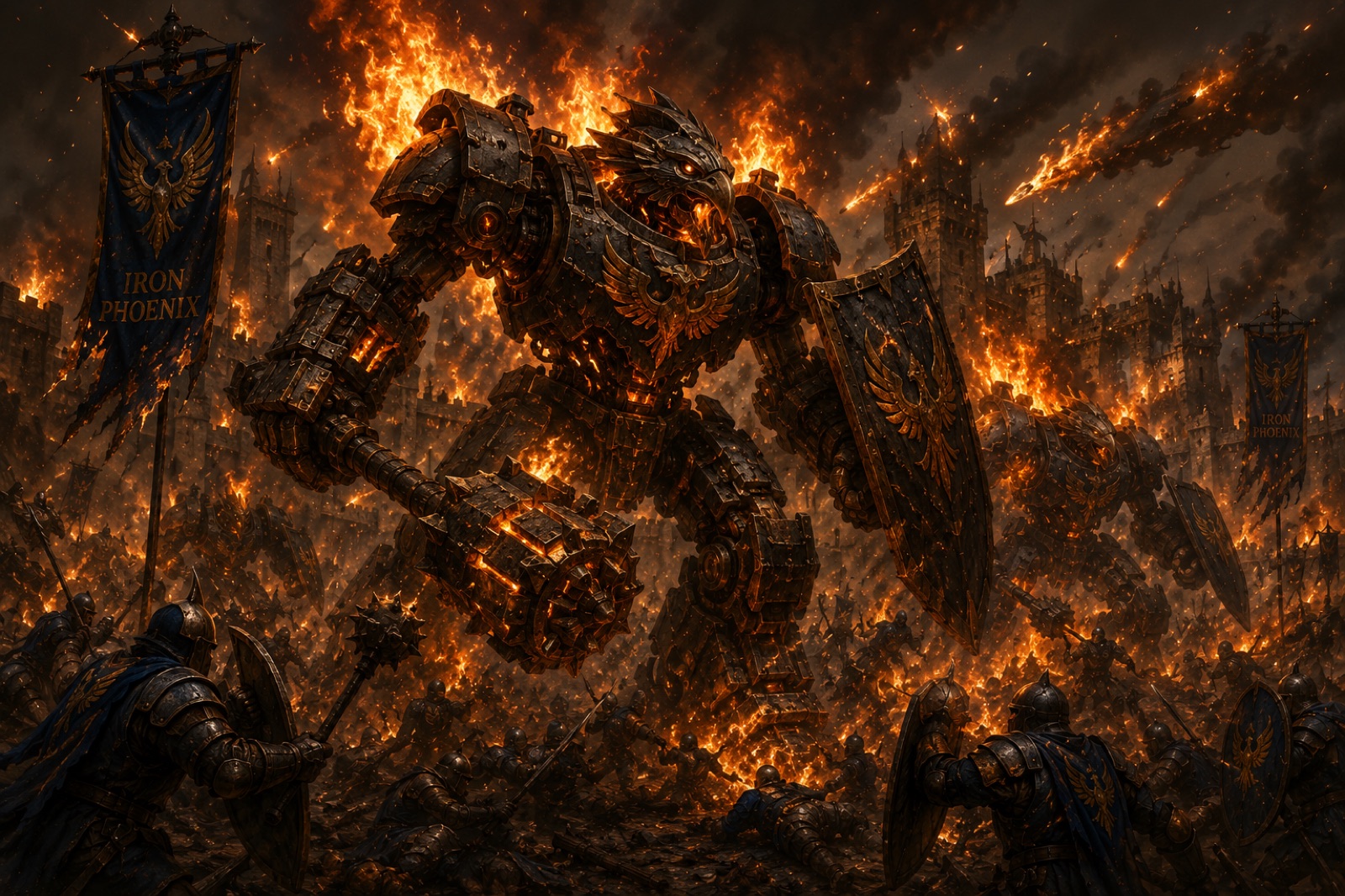
The assault slowed. Then broke. Retreat spread across the valley. Hydna watched another burning Phoenix stride from the foundry. A faint smile crossed the old mercenary's face.
"The girl..." He watched the blazing construct disappear into the smoke. "...didn't build a machine. She built a legend."
Morning arrived quietly. Smoke drifted above the Refinery, carrying the scent of ash, scorched steel, and spent Domain Crystal. The valley had become a graveyard. Hundreds of bodies lay where they had fallen.
Olympians rested beside Vikings. Amazons beside Guild Nethers. Mercenaries beside men they had once fought beside for coin. The battlefield no longer spoke of kingdoms. Only of lives spent.
Here and there, the blackened remains of Iron Phoenixes still smoldered, their twisted frames half-buried beneath those they had destroyed. Hydna stood upon the western wall overlooking the valley. Velther joined him. For a long time neither spoke. Finally Hydna broke the silence.
"They wanted the king."
Velther nodded. "They nearly had him."
Hydna looked over the dead.
"No, They nearly had all of us."
Chapter Five: The Long Campaign
The Battle of the Refinery marked the last great battle of the campaign.
After that, the war changed.
The Ideology no longer gathered companies capable of meeting Sartonia in battle. Instead they fractured, scattering into isolated valleys and forgotten villages beyond the frontier. Sartonian patrols secured roads by day only to find fresh banners hanging there by morning. Every captured commander was replaced by another willing to continue the struggle.
Victory became increasingly difficult to measure.
Velther's name spread throughout the frontier as stories of impossible victories followed him from one battlefield to the next.
Hydna became something altogether different.
No one could remember every siege he had broken, every retreat he had turned into survival, or every fortress he had somehow kept standing against impossible odds. Soldiers stopped asking how he managed it.
They simply hoped he would be there.
Meanwhile the Royal Campaign Ledger transformed the war itself. Warriors from every corner of Eucos crossed the Shimmering Atlant in search of contracts, glory, and coin. What had begun as Sartonia's army slowly became the greatest gathering of mercenary companies the world had ever seen.
Yet despite every victory… The question never changed. Where had the order come from? No prisoner knew. No captured document explained it. The Architect had died before revealing anything of value.
Every trail ended the same way. Silence. Eventually the reports reaching Whitesalt began to change. Large attacks became uncommon. Supply routes remained open.
The scattered remnants of the Ideology no longer possessed the strength to threaten Sartonia directly. Blackspear delivered its conclusion to the High Council. The campaign had achieved its strategic objectives. King Aurelion signed the order ending military operations. And one by one the frontier outposts were abandoned.
The Refinery was stripped of its remaining Domain Crystals before its gates were sealed for the final time.
The banners of Sartonia disappeared from the distant valleys as transports carried weary soldiers home across the Shimmering Atlant.
They returned not as conquerors… but as veterans.
For the first time since the fall of the Shimmering Spire, Sartonia possessed an army that had truly experienced war. The kingdom celebrated. Velther returned a hero. Hydna quietly collected the final payment of his contract before disappearing as suddenly as he had arrived. Reios slipped back into the wilderness without ceremony.
Deep beneath Francesca's laboratories, Operation Iron Phoenix was dismantled, its blueprints sealed behind vaults that few even knew existed. Across Sartonia bells rang. Markets reopened. Merchant ships once again crowded Whitesalt Harbor. The people called it peace. King Aurelion never did.
He stood alone upon the palace balcony overlooking the harbor as the last transports returned home. Morvesa had been avenged. The frontier had been secured. His soldiers had returned. Everything he had promised the kingdom had been accomplished. Yet one question refused to leave him.
Why?
Why had an obscure movement hidden beyond the mountains risked everything merely to murder a queen they had never known? Why had every investigation reached a dead end? Why had every prisoner known so little? He had won every battle that mattered.
Yet somehow… he felt farther from the truth than the day the war began. The sea below carried merchant vessels into the harbor once more. The city bustled with life. The kingdom celebrated victory. The king watched in silence.
Something about the war still did not make sense.
Peace returned more quickly than prosperity. The merchant fleets once again filled Whitesalt Harbor. Farmers returned to fields long neglected. Workshops that had forged armor and spearheads attempted to return to plows, tools, and trade goods.
Yet something was wrong. The prosperity King Aurelion had promised never arrived. The war had ended. Its cost had not. The Royal Treasury, once the envy of Eucos, had been emptied to feed an army unlike any the kingdom had fielded since the fall of the Shimmering Spire. Domain Crystal reserves that had taken generations to accumulate had been exhausted in a single campaign.
Taxes remained high. Families waited for prosperity that never seemed to come. The people did not blame the soldiers. They blamed the war.
Meanwhile, those who had prospered during the campaign continued to flourish. Mercenary companies returned home with fortunes beyond imagination. Weapons foundries remained busy filling foreign contracts. Crystal refiners expanded their operations. Transport guilds grew richer than some noble houses. War had created an entire economy of its own.
Peace struggled to compete with it. In the halls of the High Council, questions quietly replaced celebration. How long would recovery take? Had the campaign truly been worth the cost? Could the kingdom afford another war should one come?
No one questioned the courage of the army. No one questioned the sacrifice of those who had fought. Only the judgment that had led them there. King Aurelion answered every inquiry with the same quiet confidence.
"If the price of peace is high… then the price of surrender would have been higher."
At first many still believed him. But as time passed… fewer did.
Then came a request that seemed entirely reasonable. Not an investigation. Not an accusation. Simply an accounting. A Commission of Inquiry was assembled by the High Council to answer a single question.
Had the campaign accomplished the purpose for which it had been fought?
No one in the chamber realized they had just asked the question that would unravel a king.
The Commission convened in the Hall of Records beneath the High Council. No banners adorned the chamber. No speeches celebrated the campaign. Its purpose was neither praise nor blame. It existed to preserve history.
The Royal Archivists gathered dispatches from the frontier. Quartermasters submitted inventories. Generals delivered battle reports. Treasury officials accounted for every crystal spent, every ship commissioned, every tax levied to sustain the campaign.
The task was simple. To determine whether the war had accomplished the purpose for which it had been fought. Few doubted the answer. The army had prevailed. The frontier had been secured. The Ideology had been broken. The kingdom expected little more than an official confirmation of what everyone already believed.
The first reports passed without controversy. Veteran officers described battles fought beyond the mountains. Engineers detailed the construction of roads and fortifications. Merchants testified that trade routes once plagued by raids had become safer than they had been in generations.
The Treasury presented its findings with less enthusiasm. The campaign had consumed fortunes beyond calculation. The Royal Reserve of Domain Crystals had fallen to its lowest level since records had been kept. Emergency taxes imposed during the war remained necessary. Civilian construction had nearly ceased while military contracts flourished.
None of this surprised the Commission. Wars were expensive. Victories often were. The Commission continued. Then the questions began to change. Not from the generals.
From the historians. One elderly archivist spent his days comparing Blackspear intelligence reports against testimony taken from captured Ideology leaders. At first he believed the records incomplete. He requested additional files.
Blackspear complied. He requested translations of journals recovered from abandoned strongholds. They were delivered. He requested interrogation records. Boxes filled his office. The old historian returned to the same sentence written across the margin of his notes.
Who ordered the assassination?
The records answered every question except that one. The Ideology advocated revolution. It had attacked caravans. It had murdered governors. It had burned villages loyal to Sartonia. Its hatred of kingdoms was undeniable. Its guilt in countless atrocities was beyond dispute. Yet nowhere… not in a single captured order… not in a single confession… not in a single intercepted message… did anyone claim responsibility for the murder of Queen Morvesa?
The historian assumed he had overlooked something. He searched again. Nothing. He searched a third time. Still nothing. Eventually he carried his findings before the Commission.
"I believe the record is incomplete."
The chairman frowned. "In what way?" The historian carefully placed several ledgers upon the table. "We possess overwhelming evidence that the Ideology waged war against Sartonia."
Heads nodded around the chamber.
"We possess overwhelming evidence that the campaign successfully dismantled their organization." More agreement. He opened the final ledger.
"What we do not possess...is evidence that they ordered the assassination that began the war."
Silence. The chairman leaned forward.
"Are you suggesting they were innocent?" The old historian shook his head immediately.
"No, they were murderers. "They were terrorists. "They deserved to be opposed."
He rested one hand upon the report. "But history requires precision." He looked around the chamber.
"We have proven they were our enemy." He closed the ledger. "We have not proven they killed our Queen."
No one spoke. For the first time since the campaign had begun… the official story no longer fit the evidence. King Aurelion refused to allow doubt to define the kingdom. If the people questioned the purpose of the war, he would remind them of its heroes. He traveled farther than any monarch before him. Every province. Every major city. Every harbor.
He visited hospitals, military academies, rebuilt villages, and the families of the fallen. Wherever he appeared, he spoke not of victory, but of sacrifice. "The peace we enjoy," he often said, "was purchased by those who chose duty over comfort."
The crowds applauded. Yet the applause grew quieter with each passing season. Recognizing the affection the people still held for the campaign's greatest heroes, Aurelion increasingly invited them to stand beside him.
Velther, now the kingdom's most celebrated soldier, became a familiar sight within the Royal Court. He accepted every invitation reluctantly, looking far more comfortable in worn armor than embroidered ceremonial dress. Veterans admired him. Children idolized him. Even those who questioned the war rarely questioned Velther.
Francesca proved equally beloved.
Her inventions had transformed Sartonia beyond the battlefield. Bridges rose faster than ever before. Mills turned more efficiently. Crystal-powered machinery eased the burden of labor across the kingdom. Wherever she demonstrated a new creation, crowds gathered in amazement.
Together they became symbols of everything the campaign had achieved. Whenever the King addressed the people, one or both often stood nearby. Not as ornaments. As reminders. The war had produced heroes. The war had produced progress. The war had made Sartonia stronger.
For a time… the message worked. But speeches could not refill empty purses. The harvests were good. Trade had returned. Yet prosperity remained elusive. The treasury had been drained. Emergency taxes remained in place long after the soldiers returned home. Merchants postponed expansion. Guilds reduced wages. Small farms disappeared beneath unpaid debts.
Meanwhile the fortunes earned during the campaign remained concentrated in the industries that war had enriched. Mercenary companies had never been wealthier. Weapons foundries continued producing arms for foreign buyers. Crystal refiners expanded their operations. Military contractors purchased estates once owned by old noble families. To the ordinary citizen, peace looked remarkably similar to war.
Only without the hope that tomorrow might bring victory. The questions became accusations.
"If the war is over… why are we still paying for it?"
"My son never came home." "My taxes never came down."
Then came the question no speech could answer.
"If they did not kill the Queen… why did we invade?"
No one accused Aurelion of deceit. Something more dangerous took hold. They accused him of failure. Not moral failure. Judgment. He had trusted the wrong intelligence. Led the kingdom into the wrong war. Spent the wealth of generations pursuing an enemy that, while dangerous, had not committed the crime that justified the campaign.
The heroes remained beloved. Velther's popularity never faded. Francesca's brilliance continued to inspire hope. Even the veterans retained the people's admiration. Only one reputation continued to fall. The King's.
By the time the High Council assembled for its next session, the cheers that had once followed Aurelion through the streets had become polite applause. Behind closed doors, councilors spoke in whispers. Not of treason. Not a conspiracy. But of confidence.
Could Sartonia recover while Aurelion remained upon the Sapphire Throne?